Qu Yuan
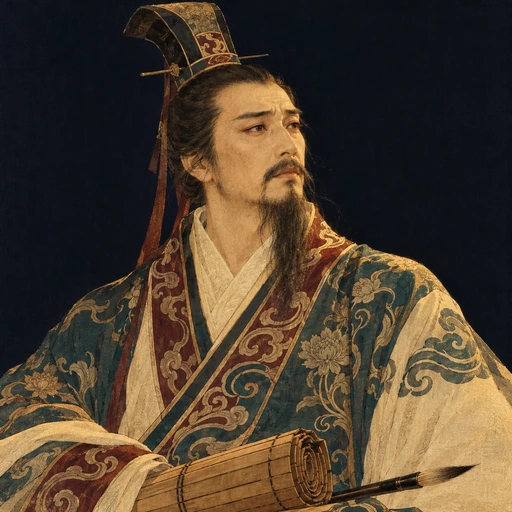
Founder of the Chu Ci poetry, who, anguished for his country and banished, wrote the Li Sao and drowned himself in the Miluo River.
Life
Ally with Qi against Qin
Qu Yuan, personal name Ping, was a noble of the State of Chu. A man of great learning, he served as zuotu (Left Adviser) and as sanlü dafu (Master of the Three Noble Clans). He advocated an enlightened legal order at home and alliance with Qi against Qin abroad, and enjoyed the trust of King Huai of Chu.
Exiled south of the Yangtze
The Shangguan Grandee and others, jealous of him, slandered him so that King Huai grew distant from him. King Huai fell for Zhang Yi's scheme and broke off relations with the State of Qi, and later, ignoring Qu Yuan's objections, went to the State of Qin, where he was detained and died. After King Qingxiang came to the throne, Qu Yuan was banished to the region south of the Yangtze.
Li Sao
In exile he wrote works including the Li Sao, the Nine Songs, the Heavenly Questions and the Nine Pieces, creating the genre of Chu Ci. In 278 BCE the Qin general Bai Qi took the Chu capital of Ying, and Qu Yuan, in grief, anger and despair, threw himself into the Miluo River and died. Later generations' Dragon Boat Festival customs of eating zongzi and racing dragon boats are popularly linked with commemorating him.
Legacy
Qu Yuan was China's first great poet known by name, and the Li Sao is paired with the Book of Songs as "Feng and Sao," the two great sources of Chinese literature.
Major works & achievements
- Li Sao
- Nine Songs
- Heavenly Questions
Did you know? "The road ahead is long and far; I shall search high and low" comes from the Li Sao.
Key dates
- 305 BCEEstranged from King Huai of Chu (approx.)
- 299 BCEUrged King Huai not to go to Qin
- 296 BCEExiled south of the Yangtze (approx.)
- 278 BCEThe Fall of Ying; drowned himself in the Miluo River