The world in 1881
1881, China: Qing (Guangxu); Iran: Qajar dynasty (Naser al-Din Shah); India: British Raj (Ripon); Rome: Kingdom of Italy (Umberto I). The main event that year: Battle of Geok Tepe.
1881: the table below lists the states and rulers of 48 regions of the world, followed by 14 events from around that year.
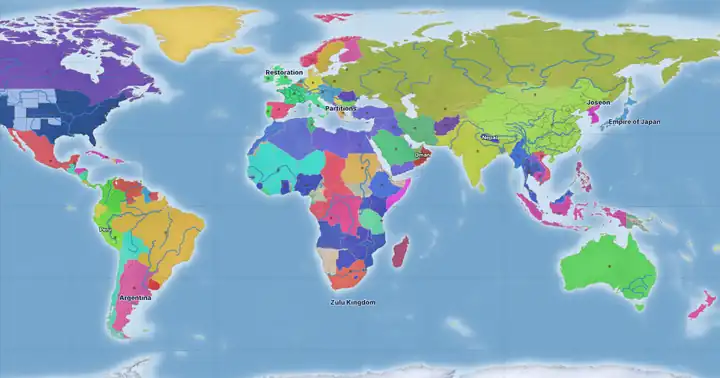
States and rulers by region
| Region | State or period | Ruler that year |
|---|---|---|
| United States | United States of America | Garfield → Arthur |
| United Kingdom | British Empire | Gladstone |
| France | French Republic | Grévy |
| Germany | German Empire | Bismarck (Chancellor) |
| Rome | Kingdom of Italy | Umberto I |
| Turkey | Ottoman Empire | Abdul Hamid II |
| Egypt | Muhammad Ali dynasty | Tewfik |
| Russia | Russian Empire | Alexander II |
| Scandinavia | Sweden–Norway union | Oscar II |
| India | British Raj | Ripon |
| China | Qing | Guangxu |
| Japan | Meiji era | Emperor Meiji (no cabinet before 1885) |
| Greece | Kingdom of Greece | George I |
| North Africa | French North Africa | — |
| West Africa | French West Africa | — |
| Ethiopia | Solomonic dynasty | Yohannes IV |
| Sudan | Turco-Egyptian rule | Muhammad Ahmad (al-Mahdi) |
| East Africa | Oman / Zanzibar | Barghash (Zanzibar) |
| South Africa | Zulu Kingdom | Cetshwayo |
| Nigeria | Sokoto Caliphate | Umaru |
| Ghana | Ashanti Confederacy | Mensa Bonsu |
| Mexico | Porfiriato | Manuel González |
| Maya | Guatemala · Honduras · Belize | — |
| Inca | Peru · Bolivia · Ecuador | — |
| Mongolia | Qing Mongolia | — |
| Indonesia | Dutch East Indies | — |
| Australia | British penal colonies | End of convict transportation |
| Spain | Restoration | Alfonso XII |
| Portugal | House of Braganza | Louis I |
| Thailand | Chakri dynasty | Rama V Chulalongkorn |
| Vietnam | Nguyễn dynasty | Emperor Tự Đức Nguyễn Phúc Thì |
| Korean Peninsula | Joseon | Gojong of Joseon (personal rule) |
| Iran | Qajar dynasty | Naser al-Din Shah |
| Saudi Arabia | Second Saudi State | Abdullah bin Faisal (restored to the throne) |
| Uzbekistan | Russian Central Asia | Alexander III (Tsar) |
| Poland | Partitions | Alexander III (Tsar) |
| Netherlands | Kingdom of the Netherlands | William III |
| Cambodia | French protectorate | Norodom (King) |
| Myanmar | Konbaung dynasty | Thibaw |
| Brazil | Empire of Brazil | Pedro II of Brazil |
| Argentina | Conservative Republic | Roca |
| Canada | Dominion of Canada | John A. Macdonald |
| Austria | Austria-Hungary | Franz Joseph I |
| Ireland | Part of the United Kingdom | Victoria |
| Afghanistan | Barakzai dynasty | Abdur Rahman |
| Caribbean | Abolition era | — |
| Baltic states | Baltic provinces of the Russian Empire | — |
| Guyana | Indentured labor era | — |
The “Ruler that year” column comes from TimelineSurf's dated lists of rulers and heads of government. A blank means no record for that year, not that the region had no ruler. A few lists are incomplete, so the name may be the most recent one on record.
Events around this year
- 1879Conquest of the Desert
Roca led a campaign south into the Pampas and Patagonia (1878–1885), crushing the Mapuche, Tehuelche and other Indigenous societies; vast lands passed to the state and to large landowners, and many Indigenous people were killed, captured or forcibly relocated. - 1879Outbreak of the War of the Pacific
Chile fought Peru and Bolivia over the nitrate fields of the Atacama (1879–1884); Chile won and took Antofagasta and Tarapacá, and Bolivia lost its access to the sea. - 1879Cocoa introduced to the Gold Coast
According to tradition, Tetteh Quarshie brought cocoa seeds back from the island of Fernando Po and planted them; cocoa cultivation then spread rapidly, and around 1911 the Gold Coast became the world's largest cocoa producer. - 1879Battle of Isandlwana
Britain invaded the Zulu Kingdom; the Zulu army wiped out part of the British force at the foot of Isandlwana, one of the worst defeats in the history of British colonial wars. - 1879Battle of Ulundi
British forces defeated the main Zulu army at the Zulu capital of Ulundi; Cetshwayo was captured and the Zulu Kingdom was partitioned into thirteen chiefdoms. - 1879Land War
Michael Davitt and Parnell organized the Land League, fighting for tenant farmers' rights through rent strikes and "boycotting"; a series of later land acts gradually turned tenants into owner-farmers. - 1880Kelly executed
Bushranger Ned Kelly, clad in homemade iron armor, was captured after a shootout with police at Glenrowan and later executed; he became a folk symbol of Australian defiance of authority. - 1881Battle of Geok Tepe
Skobelev led Russian troops in storming the Turkmen-held fortress of Geok Tepe; the defenders and inhabitants suffered heavy casualties, and the Turkmen lands were then incorporated into Russia. - 1881Tunisia becomes a French protectorate
Using border tribal clashes as a pretext, France sent troops and forced the bey to sign the Treaty of Bardo. - 1881Mahdist uprising
Muhammad Ahmad proclaimed himself "al-Mahdi" and called for the expulsion of the Turco-Egyptian rulers; uprisings broke out everywhere in response. - 1881Battle of Majuba Hill
The Transvaal Boers defeated the British at Majuba Hill, the First Boer War ended, and the Transvaal regained self-government. - 1881Urabi revolt
The officer Urabi led Egyptian soldiers and nationalists against foreign interference, and was crushed by the British army the following year. - 1882United Kingdom occupies Egypt
After suppressing the Urabi revolt, British troops occupied Egypt and imposed long-term colonial control. - 1882Chinese Exclusion Act
Congress passed the Chinese Exclusion Act, barring Chinese laborers from entering the country; it was the first US immigration law targeting a specific ethnic group, and it was repealed in 1943.