Paul Kruger
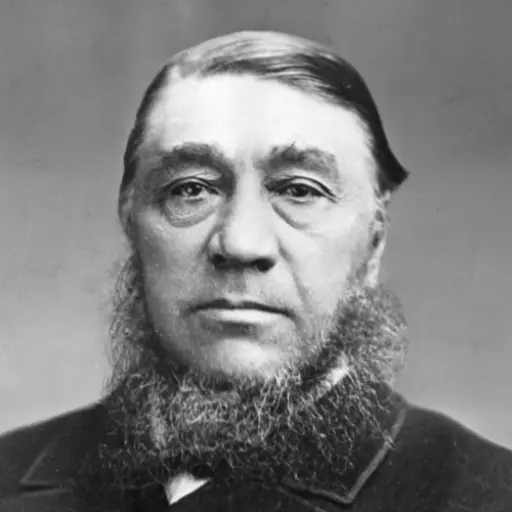

Symbol of Boer resistance to British expansion and President of the Transvaal during the Second Boer War.
Life
Boy of the Great Trek
Kruger was born in 1825 into a Boer farming family in the eastern Cape Colony and as a child joined the Great Trek north with his family, growing up in the Transvaal. He had almost no formal education and adhered to a strict Calvinist denomination. As a young man he took part in wars against African peoples and in internal Boer disputes, gradually becoming a military and political leader.
Boer president
In 1877 Britain annexed the Transvaal; Kruger went to London twice to negotiate, without success, and then helped lead the First Boer War of 1880–1881, forcing Britain to restore the Transvaal's self-government. In 1883 he was elected President of the South African Republic and was re-elected three times thereafter. After gold was discovered on the Witwatersrand in 1886, large numbers of foreign miners poured in; he refused to grant them the vote, and tensions with Britain grew ever sharper. The failure of the Jameson Raid at the end of 1895 greatly boosted his prestige among the Boers.
Exile in Europe
The Second Boer War broke out in 1899. In 1900, before British forces captured Pretoria, he left South Africa for Europe to seek support, but failed to secure intervention from any country. He died in Switzerland in 1904, and his body was brought back to Pretoria for burial. Kruger National Park is named after him, and he holds an important place in the historical memory of the Afrikaners.
Legacy
In the historical memory of the Afrikaners, Kruger is a symbol of resistance to the British Empire and defense of national independence, and South Africa's famous Kruger National Park is named after him. But the republic he led practiced racial exclusion: Black people had no political rights, and foreign miners were also excluded from voting. Later assessments generally acknowledge his tenacity and his appeal as a national leader, while pointing out that his intransigence hastened a head-on clash with Britain.
Major works & achievements
- Led the First Boer War to restore self-government
- Elected President of the South African Republic four times
- Defeated the Jameson Raid
- Sought aid in Europe during the Second Boer War
Did you know? The Krugerrand gold coin, issued by South Africa since 1967, bears his portrait on its obverse.
Key dates
- 1836Joined the Great Trek with his family
- 1877Went to London to protest British annexation
- 1881First Boer War ended
- 1883Elected President of the South African Republic
- 1896Jameson Raid failed
- 1899Second Boer War breaks out
- 1900Left South Africa for Europe
- 1904Died in Switzerland