King Wu of Zhou
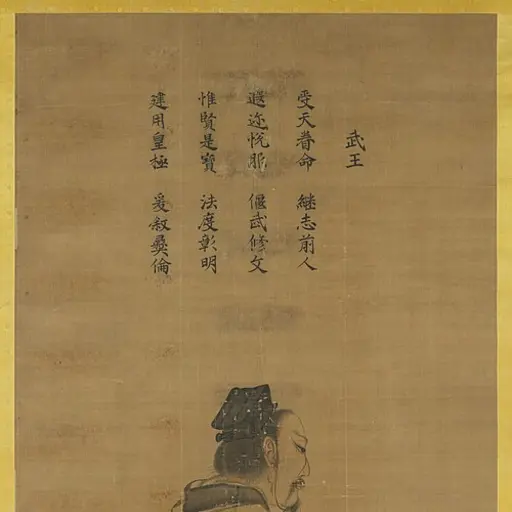

Led the allied lords to overthrow the Shang and found the Zhou dynasty, laying the foundation for the system of enfeoffment and rites.
Life
Continuing his father's work
King Wu of Zhou, Ji Fa, was the son of King Wen of Zhou and inherited the strength and prestige his father had built up in the Wei River valley. In the late Shang dynasty, King Zhou of Shang campaigned against the Eastern Yi while the court lost the loyalty of its subjects; the Zhou seized the moment, joining with the lords of the western lands and enlarging the alliance by denouncing Shang misrule, and made long military and propaganda preparations for the campaign against the Shang.
Conquest of Shang at Muye
C. 1046 BCE he led his war chariots and the allied lords east, fighting the decisive battle against the Shang army at Muye; the Shang troops changed sides on the field, King Zhou burned himself to death, and the Shang dynasty fell. After the conquest he enfeoffed members of the royal clan and meritorious officials across the land, setting up vassal lords as a protective screen for Zhou; he also resettled the Shang remnants and built Luoyi as a base for controlling the east.
Early death and legacy
King Wu reigned only briefly; after his death the young King Cheng succeeded him with the Duke of Zhou as regent, and only then were the institutions and statutes consolidated. The order of enfeoffment and clan law that he founded shaped Chinese politics for a thousand years; later Confucians held up the rule of Kings Wen and Wu as the model of ideal government, and the accounts of his deeds were often embellished by later writers.
Legacy
King Wu of Zhou completed the great enterprise of raising Zhou begun by King Wen; the Battle of Muye ended Shang rule and opened the longest-lasting dynasty in Chinese history. He and King Wen are together called "Wen and Wu" and were revered by Confucianism as sage kings, and "King Wu conquers King Zhou" became the classic narrative of the righteous overthrowing the unrighteous. He died soon after conquering Shang, and the task of consolidating the new regime fell to the Duke of Zhou, under whom the systems of enfeoffment and lineage law were gradually perfected.
Major works & achievements
- Assembled the lords at Mengjin
- Overthrew the Shang at the Battle of Muye
- Enfeoffed lords as bulwarks of Zhou
- Planned the building of Luoyi
Did you know? The Li gui bronze vessel unearthed at Lintong, Shaanxi, in 1976 bears an inscription reading "King Wu campaigned against Shang, on the morning of the jiazi day," which matches the textual records placing the Battle of Muye on a jiazi day.
Key dates
- 1050 BCESucceeds as Western Lord of Zhou
- 1048 BCEAssembled the lords at Mengjin
- 1046 BCEDefeats the Shang army at the Battle of Muye
- 1045 BCEEnfeoffed vassal lords as a protective screen for Zhou
- 1044 BCEBuilt Luoyi to manage the east
- 1043 BCEDied; succeeded by King Cheng