Emperor Taizong of Tang
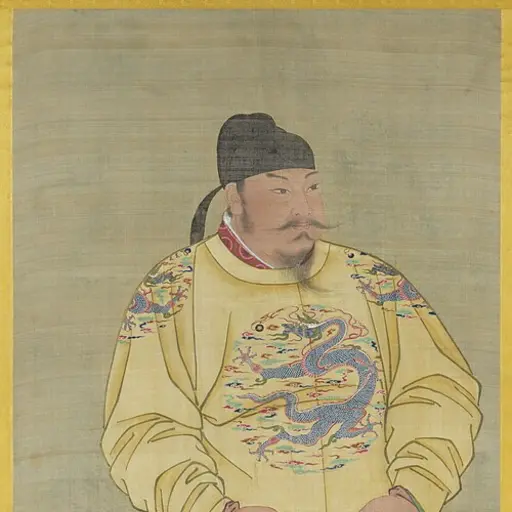

Ushered in the Reign of Zhenguan, perfected the Three Departments and Six Ministries, and was honored as Heavenly Khan.
Life
Rising in arms and early exploits
Li Shimin was the second son of Emperor Gaozu of Tang, Li Yuan. As rival warlords carved up the realm in the Late Sui, he joined his father's uprising at Taiyuan and went on to defeat Xue Ju, Liu Wuzhou, Wang Shichong and Dou Jiande. With the greatest military record of all, he was named Supreme General of Heaven's Strategy. His overshadowing merit and the struggle for the succession steadily sharpened his conflict with Crown Prince Jiancheng.
Reign of Zhenguan
In 626 he launched the Xuanwu Gate Incident, killing his brothers and forcing his father to abdicate; the next year he changed the era name to Zhenguan. During his reign he imposed light corvée and taxes, streamlined the government, perfected the Three Departments and Six Ministries and the imperial examinations, revised the legal codes, humbly heeded remonstrance, and relied on Fang Xuanling, Du Ruhui and Wei Zheng. Abroad he destroyed the Eastern Turks and was honored as Heavenly Khan by the peoples of the northwest; he extended control over the Western Regions and formed a marriage alliance with Tibet.
Achievements and controversies
The Reign of Zhenguan, famed for clean government and social stability, became the yardstick by which later ages judged good rule, though its population and wealth never surpassed the Sui dynasty at its peak, and his three campaigns against Goguryeo in his later years were costly. The bloodshed of the Xuanwu Gate Incident and his interference with the court diaries have long been debated by historians.
Legacy
Emperor Taizong of Tang is widely recognized as one of the most outstanding rulers in Chinese history. His discussions of government with his ministers were compiled by Wu Jing as the "Essentials of Government of the Zhenguan Era," which became a political textbook for later rulers and spread as far as Japan and the Korean Peninsula. Taking the attitude that "using people as a mirror, one can see one's gains and failings," he employed outspoken ministers and pursued an open policy of coexistence among many peoples. But he seized the throne through the Xuanwu Gate Incident and, breaking precedent, inspected the court diaries, so the historical records of the dynasty's early years may have been embellished, which has drawn the skepticism of later historians.
Major works & achievements
- Helped Li Yuan found the Tang and subdued rival warlords
- Inaugurated the "Reign of Zhenguan"
- Destroyed the Eastern Turks and was honored as "Heavenly Khan"
- Employed upright ministers such as Wei Zheng and readily accepted remonstrance
- Ordered the compilation of histories of earlier dynasties such as the "Book of Jin" and personally wrote some of the historical commentary
Did you know? He adored Wang Xizhi's calligraphy, and the original "Preface to the Orchid Pavilion Collection" is said to have been buried with him in the Zhao Mausoleum.
Key dates
- 617Joined his father's uprising at Taiyuan
- 621Captured Wang Shichong and Dou Jiande at the Battle of Hulao
- 626Xuanwu Gate Incident; ascends the throne
- 627Era name changed to Zhenguan; new policies launched
- 630Destroys the Eastern Turks; honored as Heavenly Khan
- 640Establishes the Protectorate General to Pacify the West to govern the Western Regions
- 641Princess Wencheng goes to Tibet in a marriage alliance (heqin)
- 645Personally led a campaign against Goguryeo without success
- 649Died of illness in Hanfeng Hall