Heraclius
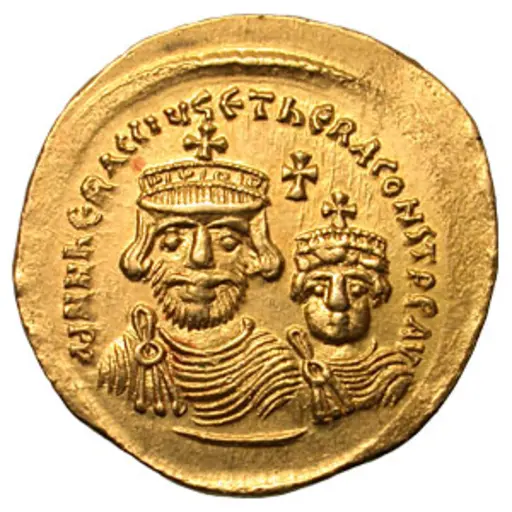

He turned back a crisis that threatened the empire's survival and crushed Persia, only to lose territory to the Arab conquest.
Life
Crowned amid crisis
Heraclius came from the family of the governor of Carthage in North Africa. In 610, taking advantage of the corruption of the Eastern Roman government and the disorder of Emperor Phocas's rule, he sailed east with a fleet, overthrew Phocas and made himself emperor. At that time the Sasanian Empire of Persia was invading westward on a large scale, capturing Syria, Palestine and Egypt one after another and at one point reaching the walls of Constantinople; the empire was on the verge of collapse.
Campaign into Persia
He reformed the army and reorganized the finances, even using church property to fund the war. From 622 he personally led his army deep into the Persian heartland, avoiding a war of attrition head-on and instead striking directly at the Sasanian core. In 627 he decisively defeated the Persian army near Nineveh; the following year a coup in Persia led it to sue for peace, and Heraclius recovered the captured relic of the True Cross, his prestige reaching its peak.
Victory slipping away
Soon after this victory, however, the new Arab Muslim power rose rapidly. In 636 the Eastern Roman army was crushed at the Battle of Yarmouk, and Syria, Palestine, Egypt and other provinces just recovered from Persia fell to the Arabs one after another; Heraclius died in grief and bitterness in his later years. Later generations often see him as a tragic figure who "turned the tide only to see victory slip away," and his brilliant triumph in the Persian wars is often overshadowed by the Arab conquest that followed, a far more pivotal turning point in history.
Legacy
Heraclius turned the tide of war when the empire was on the verge of downfall, making him one of the most dramatic emperors in Byzantine history; medieval Western European literature treated him as the hero who recovered holy relics. His reign is often seen as marking the Eastern Roman Empire's transformation from the late Roman Empire into the Hellenized medieval Byzantine state. Yet the Persian wars exhausted both great empires and paved the way for the rapid Arab expansion; late in life he promoted Monothelitism to bridge doctrinal differences, which only intensified the disputes.
Major works & achievements
- Overthrew Phocas and saved the empire from crisis
- Campaigned against Persia in person and won decisively at the Battle of Nineveh
- Restored the True Cross to Jerusalem
- Replaced Latin with Greek as the official language
Did you know? He is said to have developed a fear of the sea late in life; to cross the Bosporus he had a pontoon bridge built, screened on both sides with branches and foliage.
Key dates
- 575Born in Carthage
- 610Overthrows Phocas and becomes emperor
- 614Fall of Jerusalem; the True Cross is carried off
- 622Leads a campaign against Persia in person, turning to a strategic counteroffensive
- 627Crushed Persia at the Battle of Nineveh
- 628Persia sues for peace; the True Cross is recovered
- 636Defeated by the Arabs at the Battle of Yarmouk
- 641Died