Peter the Great
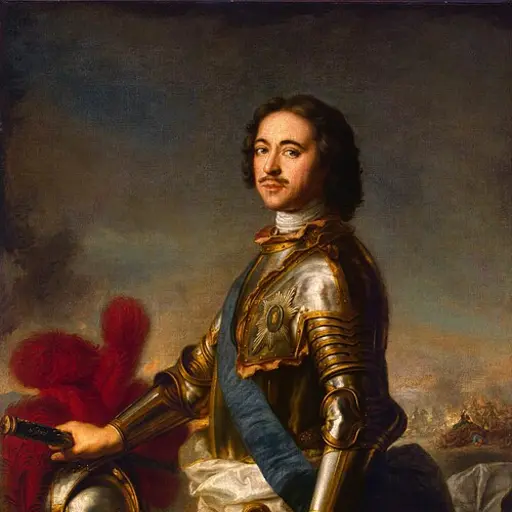

Pushed through Westernizing reforms, won an outlet to the Baltic and built Saint Petersburg.
Life
Boy tsar
Peter was the son of Tsar Alexei. At ten he was made co-tsar with his half-brother, while his half-sister Sophia ruled for years as regent; outside Moscow he formed a boys' army and became fascinated with navigation and artisan crafts. Europe then viewed Russia as a backward landlocked country lacking an ice-free port, with antiquated military and administrative institutions.
Travels and reforms
In 1697 he traveled to Western Europe incognito with the Grand Embassy, working personally in Dutch shipyards and studying military affairs and manufacturing. After returning home he reformed the army, administration and tax system, founded a navy, a newspaper and the Academy of Sciences, and forced nobles to shave their beards and adopt Western dress. From 1700 he fought the Great Northern War against Sweden, winning the decisive Battle of Poltava in 1709 and gaining an outlet to the Baltic.
A new capital and its cost
In 1703 he built Saint Petersburg on the marshes at the mouth of the Neva and moved the capital there; huge numbers of laborers died during construction. The reforms were forced through at the cost of serfdom: taxes and labor duties grew heavier and revolts broke out repeatedly, and his own son Alexei was tortured to death. Russia thereby joined the ranks of the European great powers, but the rifts in its society persisted into later generations.
Legacy
Peter the Great forcefully pushed through Westernizing reforms, raising Russia from a landlocked country on Europe's periphery to a Baltic power, and in 1721 proclaimed it an empire; this is widely seen as the beginning of Russia's modernization. But the reforms were imposed from above and relied on coercion, came at the cost of strengthening serfdom, and deepened social divisions. The debate among Russian intellectuals since the 19th century between "Westernizers" and "Slavophiles" has largely revolved around his legacy.
Major works & achievements
- Traveled to Western Europe incognito with the Grand Embassy
- Founded the Russian navy
- Defeated Sweden at the Battle of Poltava
- Built Saint Petersburg and moved the capital there
- Issued the Table of Ranks
Did you know? He once levied a beard tax, and those who paid it had to carry a copper "beard token" as proof.
Key dates
- 1682Made co-tsar with his brother Ivan
- 1689Overthrows Sophia's regency; takes real power
- 1696Captures Azov; begins building a navy
- 1697Traveled to Western Europe with the Grand Embassy
- 1700Great Northern War breaks out; defeated at Narva
- 1703Built Saint Petersburg
- 1709Great victory over Sweden at Poltava
- 1721Signs the Treaty of Nystad; takes the title of emperor
- 1725Died