Rousseau
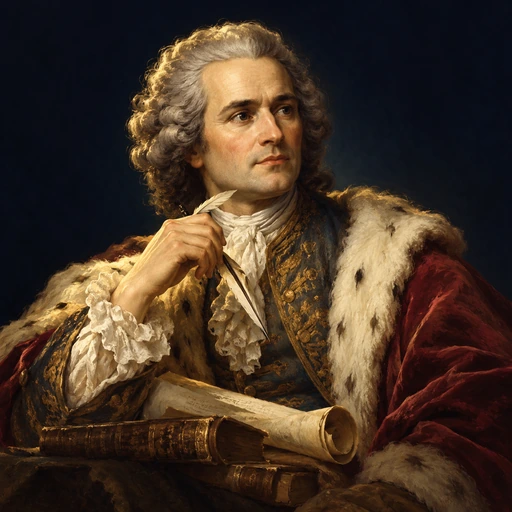
Author of The Social Contract: "Man is born free, and everywhere he is in chains."
Life
Son of a watchmaker
Rousseau was born in Geneva into a watchmaker's family. In his early years he led a wandering life, working as an apprentice, a servant and a tutor; later he came to Paris and befriended Diderot and other Encyclopedists.
The Social Contract
In 1750 he won a prize and fame with his essay Discourse on the Arts and Sciences, and went on to write the Discourse on the Origin of Inequality. In 1762 he published The Social Contract, setting out his doctrines of popular sovereignty and the general will; it opens with the line "Man is born free, and everywhere he is in chains." In the same year he published Emile, a novel on education. Both books were banned by the Parlement of Paris and the authorities of Geneva, and he was forced into exile.
Exile and Confessions
In his later years he wrote the Confessions, and his relations with Voltaire and others broke down. He died in 1778. During the French Revolution his remains were moved to the Panthéon.
Legacy
Rousseau's idea of popular sovereignty profoundly influenced the French Revolution, and his works also opened the way for Romantic literature.
Major works & achievements
- The Social Contract
- Emile
- Confessions
- Julie, or the New Heloise
Did you know? He sent all five of his children to a foundling hospital, and later expressed deep remorse over it in his Confessions.
Key dates
- 1750Discourse on the Arts and Sciences wins a prize
- 1755Discourse on the Origin of Inequality
- 1762Publishes The Social Contract and Emile; forced into exile
- 1770Completes Confessions (approx.)
- 1778Died