Kublai Khan
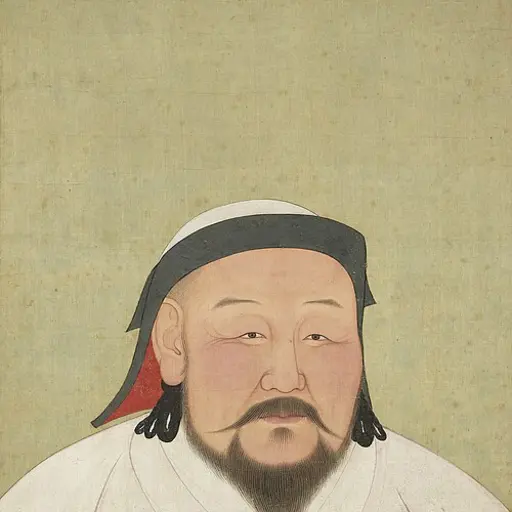

Founded the Yuan dynasty and conquered the Southern Song; the first steppe regime to rule all of China.
Life
In Charge of the Southern Gobi
Kublai Khan was the son of Tolui and grandson of Genghis Khan. After Möngke Khan took the throne, Kublai was put in charge of military and civil affairs in the Han lands of the Southern Gobi. At Jinlianchuan he gathered Han scholars such as Liu Bingzhong and Yao Shu and studied Chinese methods of government, gradually diverging from princes who favored ruling purely in the steppe manner.
Era Name and Unification
In 1260 Möngke died with the army in Sichuan, and Kublai proclaimed himself Great Khan at Kaiping; he won a four-year succession struggle with his younger brother Ariq Böke, but the empire in effect split into several khanates. In 1271 he adopted the dynastic name Great Yuan and moved the capital to Dadu, and in 1279 he conquered the Southern Song and unified the country. He set up the Branch Secretariat (province) system, opened canals, issued paper money, and employed Mongol, Semu and Han officials alike.
Merits and Faults
He imposed the Four-Class System, with Mongols and Semu at the top and northern and southern Chinese restricted, so social tensions built up over time; two invasions of Japan and southern campaigns against Annam all failed at great cost. The Yuan dynasty brought Tibet and Yunnan into the central administrative system, its Branch Secretariat system influenced later provincial systems, and Eurasian exchange reached new heights in his time.
Legacy
The Yuan dynasty founded by Kublai Khan ended the long period of division that had lasted since the Late Tang and laid the territorial foundation of China as a unified multiethnic state; its Branch Secretariat (province) system was also inherited by later dynasties. He adopted institutions from the Central Plains and promoted exchanges and economic ties between China and other lands. But the ethnic hierarchy he imposed sharpened social conflicts, his expeditions against Japan, Annam, Java and elsewhere repeatedly failed, and the heavy financial burden sowed the seeds of the Yuan dynasty's decline in its late period.
Major works & achievements
- Adopted the dynastic name Great Yuan in 1271
- Conquered the Southern Song in 1279 and unified the country
- Established the Branch Secretariat (province) system
- Brought Tibet and Yunnan under central rule
- Dug canals so that grain transport reached Dadu directly
Did you know? The site of Shangdu was inscribed on the World Heritage List in 2012.
Key dates
- 1251Put in charge of the Han lands of the Southern Gobi
- 1259Led an attack on Ezhou
- 1260Took the throne as Great Khan at Kaiping
- 1264Defeats Ariq Böke; makes Yanjing the capital
- 1271Named the dynasty Great Yuan
- 1274First invasion of Japan fails
- 1279Destroyed the Southern Song at the Battle of Yamen
- 1281Second invasion of Japan; fleet lost in a storm
- 1294Died of illness in Dadu