Nader Shah
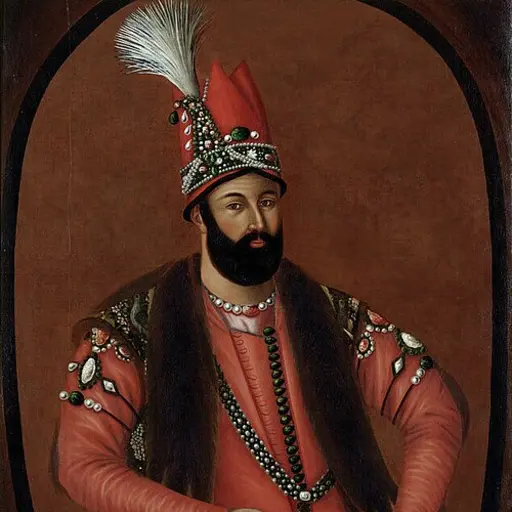

Rising from a tribal warrior, he rebuilt Iran and captured Delhi, and was called the "Napoleon of Persia."
Life
Tribal warrior
Nader came from an ordinary family of the Turkic Afshar tribe in Khorasan; as a youth he is said to have been carried off by the Uzbeks before escaping home. In the turmoil of the late Safavid period he rose by leading raiding bands, gradually gathering a formidable armed force. After the Afghans took Isfahan in 1722, he entered the service of the exiled Safavid prince Tahmasp II and was made commander.
Restoring the state and becoming shah
In 1729 he defeated the Afghans at Damghan and other battles and recaptured Isfahan, then drove Ottoman and Russian forces out of western and northern Iran. In 1732 he deposed Tahmasp II and installed his infant son as Abbas III, and in 1736, at an assembly on the Mughan Plain, he proclaimed himself shah. He tried to reconcile Shia and Sunni Islam and reorganized the army, equipping it extensively with muskets and light artillery.
Eastern campaigns and downfall
From 1738 he campaigned east, taking Kandahar and Kabul; in 1739 he inflicted a crushing defeat on the Mughal army at Karnal, entered Delhi, and carried off the Peacock Throne and the Koh-i-Noor diamond; he then conquered Bukhara and Khiva. In his later years he grew suspicious, cruel and extortionate; in 1742, suspecting his eldest son of involvement in an assassination attempt, he had him blinded, and revolts broke out one after another. In 1747 he was assassinated by his subordinates in his camp in Khorasan, and his vast empire promptly collapsed.
Legacy
After the collapse of the Safavid dynasty, Nader Shah reunified Iran and, through a series of expeditions, briefly made it the most powerful military state in western Asia; he is often called the "Napoleon of Persia" or the "last great Asian conqueror." Yet his empire rested on personal military might; in his later years he imposed crushing taxes and killed indiscriminately, and it collapsed rapidly after his death. His sack of Delhi also severely weakened the Mughal Empire, indirectly giving the British an opening to expand in India.
Major works & achievements
- Expelled the Afghans and recaptured Isfahan
- Proclaimed himself shah in 1736
- Defeated the Mughal army at the Battle of Karnal
- Conquered Bukhara and Khiva
Did you know? The Koh-i-Noor diamond he carried off from Delhi is now set in a crown of the British royal family.
Key dates
- 1688Born in Khorasan
- 1726Entered the service of Tahmasp II
- 1729Expelling the Afghans and recapturing Isfahan
- 1736Proclaimed shah on the Mughan Plain
- 1739Battle of Karnal and entering Delhi
- 1740Conquered Bukhara and Khiva
- 1747Assassinated