Qianlong Emperor
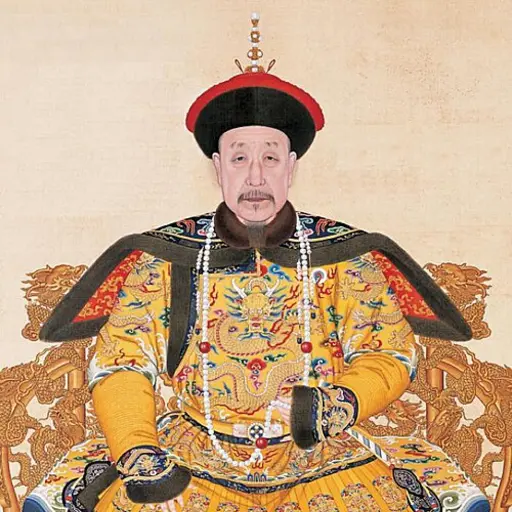

Reigned 60 years, as the Qing dynasty's territory and civil governance reached their zenith.
Life
Peaceful succession
Hongli was the fourth son of the Yongzheng Emperor. Clever from childhood, he was a favorite of his grandfather the Kangxi Emperor, and he came to the throne at 25. By then the Qing dynasty had enjoyed the recovery of the Kangxi and Yongzheng reigns, the treasury was full, and he inherited an empire that was economically prosperous with fairly secure borders.
Ten Great Campaigns
During his reign he pacified the Dzungars and the Khoja brothers, bringing the lands north and south of the Tianshan into the empire, and several times sent troops against Myanmar, Annam and Greater and Lesser Jinchuan, boasting of his "Ten Great Campaigns." At home he had the Siku Quanshu compiled while launching literary inquisitions to suppress dissent. In his later years he favored Heshen, administration grew increasingly corrupt, and the White Lotus Rebellion was already brewing.
Shadows of a golden age
He often styled himself the "Old Man of the Ten Perfect Achievements," flaunting his military and civil accomplishments, but his later campaigns were enormously costly and of mixed results, not all complete victories; the compilation of the Siku Quanshu was also accompanied by the large-scale destruction and alteration of books deemed harmful to Qing rule. When he received the British Macartney embassy in 1793 he insisted on Celestial Empire court ritual and rejected its trade requests, a diplomatic stance later often seen as an emblematic moment when the Qing missed the chance to understand a changing world.
Legacy
Under Qianlong the Qing dynasty's territory reached its zenith, establishing the basic shape of modern China's borders, and population and the economy were at their peak. He oversaw compilation of the Siku Quanshu, preserving a vast number of texts, while using the project to ban, destroy and alter large numbers of books; his literary inquisitions were especially harsh. In his later years he craved grandeur and glory and trusted the favorite Heshen, administration decayed, and social tensions mounted. His dismissive attitude toward the Macartney embassy is often seen as epitomizing the Qing's isolation from world trends.
Major works & achievements
- Pacified the Dzungars and the Khoja brothers
- Unified the lands north and south of the Tianshan
- Oversaw compilation of the Siku Quanshu
- Ruled from behind the scenes after abdicating
Did you know? He lived to over eighty and is generally considered the longest-lived emperor in Chinese history.
Key dates
- 1736Ascended the throne; reign title changed to Qianlong
- 1755Crushed the Dzungar rebellion
- 1759Revolt of the Khoja brothers suppressed; unified the lands north and south of the Tianshan
- 1773Began compiling the Siku Quanshu
- 1786Lin Shuangwen uprising broke out in Taiwan
- 1793Received the Macartney embassy; rejected trade
- 1796Abdicated in favor of the Jiaqing Emperor
- 1799Died; in fact he had continued to wield power as retired emperor until then