Modu Chanyu
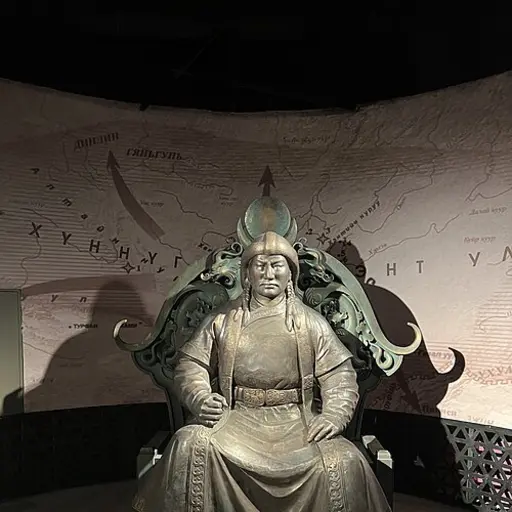

Founder of the Xiongnu Empire, who first united the tribes of the Mongolian Plateau into a powerful nomadic empire.
Life
Killed his father with whistling arrows
Modu was the crown prince of Touman Chanyu of the Xiongnu. According to the Records of the Grand Historian, Touman favored the son of a later wife and sent Modu as a hostage to the Yuezhi to the west, then attacked the Yuezhi, hoping they would kill him. Modu stole a fine horse and escaped home, and Touman had no choice but to give him command of 10,000 horsemen. Modu made whistling arrows to train his men: anyone who failed to shoot where the whistling arrow was aimed was beheaded. In 209 BCE, during a hunt, he shot a whistling arrow at his father; his men followed with a salvo, Touman was killed, and Modu made himself chanyu.
Unified the steppe
Early in his reign, the Donghu to the east demanded first a thousand-li horse and then one of his yanzhi (consorts), and Modu granted both; when the Donghu then demanded the empty land between the two peoples, he declared that "land is the foundation of a state," launched a surprise attack and destroyed the Donghu in one stroke. He then struck the Yuezhi in the west, annexed the Loufan and Baiyang to the south, recaptured the Henan region that the Qin general Meng Tian had seized, and subdued the Hunyu, Qushe, Dingling and other peoples to the north. The Xiongnu established 24 chiefs, including the Worthy Kings of the Left and Right and the Luli Kings of the Left and Right, forming a military and administrative system for governing the vast steppe.
Baideng and the marriage alliance
In 200 BCE, Emperor Gaozu of Han, Liu Bang, personally led a great army north to strike the Xiongnu, but was surrounded by Modu for seven days at Mount Baideng near Pingcheng and escaped only after lavish gifts were used to win over Modu's yanzhi. Thereafter the Han dynasty adopted the heqin marriage-alliance policy, marrying women of the imperial clan to the chanyu and sending silk floss, wine and rice every year. In 176 BCE Modu wrote to Emperor Wen of Han, claiming to have pacified Loulan, the Wusun and 26 states of the Western Regions, "all of which have become Xiongnu." Modu died in 174 BCE, and the Xiongnu Empire he built became the prototype for steppe empires over the next 2,000 years.
Legacy
Modu Chanyu was the first to unite the tribes of the Mongolian Plateau into a powerful nomadic state, and his decimal military organization and system of dividing rule between left and right wings became the model for later steppe empires such as the Xianbei, the Turks and the Mongols. The early Han was forced to buy peace on the frontier with marriage alliances (heqin) and annual tribute, and only under Emperor Wu of Han did it switch from defense to offense. The Xiongnu themselves left no writings, and their image has come down mainly through the "Account of the Xiongnu" in the Records of the Grand Historian, whose record inevitably reflects the stance of the Central Plains dynasty.
Major works & achievements
- Trained his troops with whistling arrows, killed his father and took power
- Destroyed the Donghu in the east, struck the Yuezhi in the west, and unified the Mongolian Plateau
- Set up the 24 chiefs, including the Wise Kings of the Left and Right
- Besieged Emperor Gaozu of Han at Mount Baideng for seven days
Did you know? Modu once sent Empress Lü an insolent letter; furious, she wanted to send troops against him, but Ji Bu talked her out of it.
Key dates
- 209 BCEKilled Touman Chanyu with whistling arrows and made himself ruler
- 206 BCEDestroyed the Donghu in the east
- 205 BCEStruck the Yuezhi in the west; annexed the Loufan and Baiyang to the south (approximate date)
- 200 BCESiege of Baideng: Emperor Gaozu of Han trapped for seven days
- 198 BCEFirst Han-Xiongnu marriage alliance (heqin)
- 176 BCEWrote to Emperor Wen of Han, claiming to have pacified the states of the Western Regions
- 174 BCEDied