J. Robert Oppenheimer
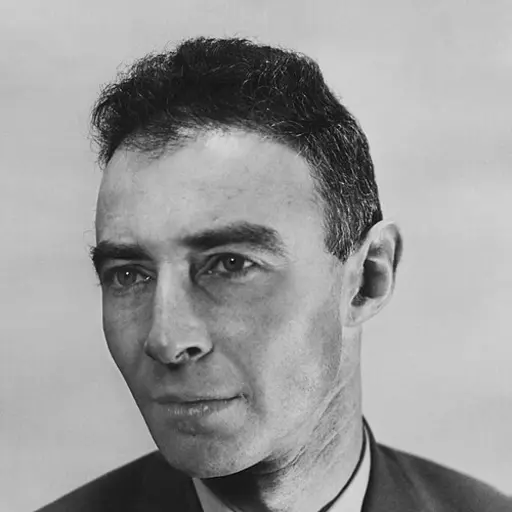

Directed the Manhattan Project to build the atomic bomb; later strove to block development of the hydrogen bomb.
Life
Study and Teaching
Oppenheimer was born in New York to a family of German-Jewish immigrants. He studied at Harvard, Cambridge and Göttingen, under Max Born, one of the founders of quantum mechanics, and after returning home he built a major center of theoretical physics research in the United States at the University of California, Berkeley, training a great many students.
Los Alamos
In 1942 he was appointed to lead the Manhattan Project's nuclear weapons laboratory at Los Alamos, New Mexico, coordinating many scientists to solve the problems of atomic bomb design. In July 1945 the first atomic bomb was successfully tested; he later quoted a scripture of Hinduism, lamenting, "I am become Death, the destroyer of worlds." The United States then dropped atomic bombs on Hiroshima and Nagasaki.
Security Hearing
After the war he served as an adviser to the Atomic Energy Commission and publicly opposed building the far more powerful hydrogen bomb. In 1954, at the height of McCarthyism, he was accused of being a "security risk" because of his early left-wing associations and stripped of his security clearance; only in 2022 did the U.S. government formally vacate that ruling. He thus carries a dual historical image as both the "father of the atomic bomb" and a "victim of conscience."
Legacy
Oppenheimer led the development of the atomic bomb with outstanding organizational skill and is called the "father of the atomic bomb"; the school he built at Berkeley also drove the rise of American theoretical physics. After the war he advocated international control of nuclear energy and opposed a hasty push to develop the hydrogen bomb. In 1954 he was stripped of his security clearance in a politicized hearing, becoming a prime example of the political persecution of scientists in the McCarthy era. His complex attitude toward nuclear weapons reflects the ethical dilemmas in the relationship between science and state power.
Major works & achievements
- Led the Los Alamos Laboratory
- Directed the "Trinity" nuclear test in 1945
- Proposed the Oppenheimer–Snyder model of gravitational collapse
- Director of the Institute for Advanced Study, Princeton
Did you know? He chose the nuclear test's code name, "Trinity"; one account says it was inspired by the work of the poet John Donne.
Key dates
- 1927Earns a doctorate from the University of Göttingen
- 1936Founds a research group at Berkeley
- 1942Led the Los Alamos Laboratory
- 1945Leads the first successful nuclear test
- 1947Director of the Institute for Advanced Study at Princeton
- 1949Opposed developing the hydrogen bomb
- 1954Security clearance revoked
- 1967Died in Princeton