Charles de Gaulle
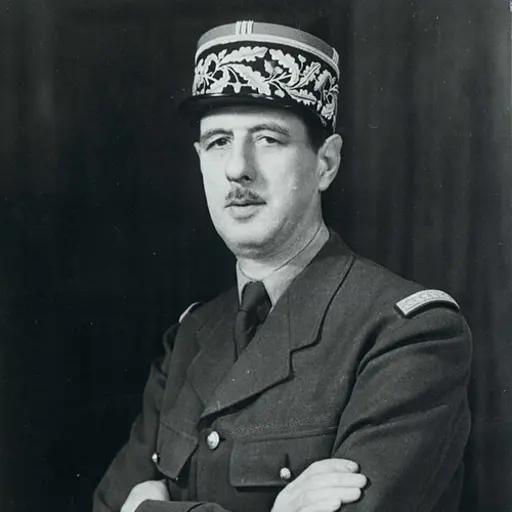

Led the Free France resistance movement and later founded the Fifth Republic.
Life
Dissenter in the Army
Born into a Catholic teacher's family in Lille, de Gaulle attended the Saint-Cyr military academy and was wounded and captured in World War I. Between the wars he clashed with the conservative French high command by advocating mechanized armored forces; his theoretical writings were ignored until the German blitzkrieg in the West in 1940 proved them right.
Free France
In 1940, as France collapsed and the Pétain government sought an armistice, he flew to London and called on the French by radio to keep resisting, forming the "Free France" forces. In 1944 he entered liberated Paris with the Allies and became Chairman of the Provisional Government. In 1958, when the Algeria crisis paralyzed the Fourth Republic, he returned to power, introduced a new constitution, founded the Fifth Republic with power concentrated in the presidency, and was elected President.
Fifth Republic
He is seen as a symbol of wartime resistance and of France's postwar great-power status, and in office he built up a nuclear force and pursued independent diplomacy. But on Algeria he shifted from upholding "French Algeria" to accepting its independence, which the far right regarded as betrayal, and the social upheaval of May 1968 exposed a deep disconnect between his late government and the younger generation; the following year he resigned after losing a referendum.
Legacy
De Gaulle is seen by the French as a symbol of the wartime spirit of resistance and of national dignity. The Constitution of the Fifth Republic he founded remains in force today, and "Gaullism," with its emphasis on national sovereignty, independent defense and multipolar diplomacy, long shaped French foreign policy; in 1964 France also became the first major Western power to establish diplomatic relations with the People's Republic of China. Critics consider his style of governing autocratic, and the Algeria question and the social crisis of 1968 exposed the limits of his system.
Major works & achievements
- Issued the "Appeal of 18 June" to his compatriots in 1940
- Led the Free French movement
- Founded the French Fifth Republic
- Established diplomatic relations with China in 1964
- Developed France's independent nuclear force
Did you know? The Appeal of 18 June was not recorded on the day it was broadcast; the recording that survives today is of the speech re-recorded a few days later.
Key dates
- 1940Calls for continued resistance in a London broadcast
- 1940Organizes the Free French Forces
- 1944Entered Paris; Chairman of the Provisional Government
- 1946Resigns over constitutional disagreements
- 1958Returns to draft the Fifth Republic's constitution
- 1959Elected President of France
- 1962Recognizes Algerian independence
- 1968Social unrest of May 1968
- 1969Resigns after losing a referendum