Enrico Fermi
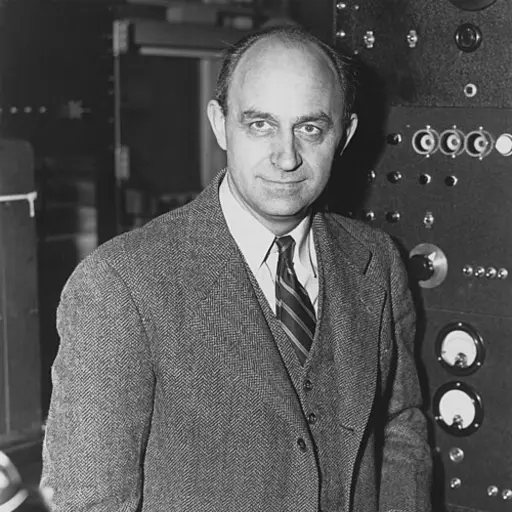

Achieved the first controlled nuclear chain reaction and took part in developing the atomic bomb.
Life
Prodigy of Rome
Fermi was born in Rome into the family of a railway clerk. In his early twenties he was already renowned in Italian physics for excelling at both theory and experiment. As a professor at the University of Rome he bombarded many elements with neutrons and systematically studied nuclear reactions, at a time when Italy was under Mussolini's Fascist rule.
Emigration and the Reactor
In 1938 he used the trip to Stockholm to receive the Nobel Prize in Physics to leave for the United States with his Jewish wife. He then led a research group at the University of Chicago, and in December 1942, beneath the stands of a stadium, built humanity's first nuclear reactor, achieving a sustained, controlled chain reaction and providing key technical validation for the development of the atomic bomb.
Atomic Age
He then joined the Manhattan Project at Los Alamos, directly contributing to the creation of the atomic bombs dropped on Hiroshima and Nagasaki. After the war he opposed developing the far more powerful hydrogen bomb, considering it pure arms racing, but he is still regarded as one of the "fathers of the atomic bomb"; assessments of him have therefore long been divided between "brilliant physicist" and "the man who opened the Pandora's box of weapons of mass destruction."
Legacy
Fermi was one of the rare physicists who reached the very top in both theory and experiment. His work on beta decay, neutron physics and quantum statistics was far-reaching, and the first nuclear reactor opened the nuclear age; the fermion, the Fermi level and element 100, fermium, are all named after him. He took part in developing the atomic bomb and after the war opposed developing the hydrogen bomb. His scientific achievements and the ethical questions raised by nuclear weapons remain unavoidable topics in assessing this generation of physicists.
Major works & achievements
- Proposed the theory of beta decay
- Proposed Fermi–Dirac statistics
- Discovered nuclear reactions induced by slow neutrons
- Built the first nuclear reactor in 1942
- Won the Nobel Prize in Physics in 1938
Did you know? At the first nuclear test he dropped scraps of paper and estimated the explosion's yield from how far the blast wave carried them.
Key dates
- 1926Became professor of Theoretical physics at the University of Rome
- 1934Proposed the theory of beta decay
- 1938Moved to the United States after winning the Nobel Prize
- 1942Built the first controlled Nuclear reactor
- 1944Joined the Manhattan Project
- 1945Witnessed the First nuclear test
- 1949Opposed developing the hydrogen bomb
- 1954Died in Chicago