Abd al-Qadir
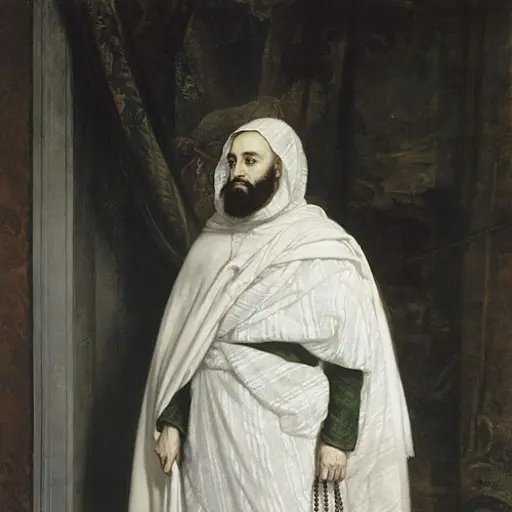

Led Algeria's resistance to the French colonial invasion for more than a decade.
Life
Sufi family
Abd al-Qadir was born near Mascara, Algeria, into a family of Sufi religious notables. In his youth he made the pilgrimage to Mecca with his father and traveled to Damascus, Baghdad and elsewhere, becoming deeply versed in Islamic learning. In 1830 France sent troops to occupy Algiers, and two years later the tribes chose him as emir to lead the resistance to the French colonial invasion.
Emir against France
He united many Arab and Berber tribes of the west and center and built a state with an administration, a tax system and a standing army. For years he thwarted French offensives with guerrilla tactics and several times signed truces with France demarcating spheres of influence. But the French kept sending reinforcements and used scorched-earth tactics to destroy villages and granaries, and in 1847, hopelessly outnumbered, he finally surrendered to the French army.
Last years in Damascus
After his surrender he was imprisoned in France for several years. Once released he settled in Damascus, and in 1860 he was honored by several governments for protecting the local Christians from massacre during sectarian strife; in his later years his image became that of a model religious warrior. After Algerian independence he was revered as the foremost national hero, but his harsh suppression of disobedient tribes while building his state in his early years is seldom mentioned in the country's historical writing.
Legacy
Abd al-Qadir led Algeria's 15-year resistance to France and attempted to build a state with the rudiments of a modern nation, and Algeria honors him as a national hero and a forerunner of the modern state. In his later years he protected Christians in Damascus, winning wide international respect and becoming regarded as a model of religious tolerance. Scholars also debate his early treatment of tribes that refused to submit and his role after his surrender.
Major works & achievements
- Chosen Emir to lead resistance to France
- Built a state with an administration and a standing army
- Signed the Treaty of Tafna
- Protects the Christians of Damascus in 1860
Did you know? The small town of Elkader in Iowa, United States, is named after him.
Key dates
- 1827Makes the pilgrimage to Mecca with his father
- 1830France sends troops to occupy Algiers
- 1832Chosen as emir to lead the resistance
- 1837Signs the Treaty of Tafna with France
- 1839Fighting resumes; French scorched-earth offensive
- 1847Surrenders to the French army
- 1860Protects the Christians of Damascus
- 1883Died in Damascus