Michael Faraday
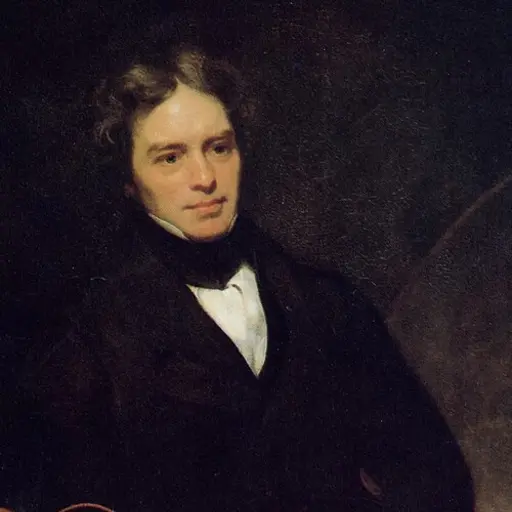

Discovered electromagnetic induction, laying the foundation for the generator and the electric motor.
Life
Bookbinder's apprentice
Faraday was born into a blacksmith's family on the outskirts of London. As a boy he was apprenticed to a bookseller binding books, which gave him the chance to read widely, and he developed a keen interest in chemistry and electricity. He wrote to the chemist Davy offering his services and was taken on as an assistant at the Royal Institution, escaping his humble origins and entering the most dynamic scientific circle of the day.
Electromagnetic induction
In 1821 he built a prototype device demonstrating electromagnetic rotation, and in 1831 he discovered electromagnetic induction, showing that a changing magnetic field can produce an electric current, which led him to invent the earliest generator. He also proposed the concept of "lines of force" for electric and magnetic fields, studied the laws of electrolysis and first isolated benzene, leaving a vast body of laboratory notes over his lifetime.
Master experimenter
Because Faraday was unversed in mathematics, his idea of lines of force was fully accepted by physicists only after Maxwell expressed it in equations, and the two are often mentioned together. Throughout his life he declined a knighthood and many other honors to concentrate on laboratory work, and later generations regard him as a model of experimental physics, though for the same reason his theoretical influence was partly underestimated by some contemporary scholars during his lifetime.
Legacy
Faraday was one of the greatest experimental physicists in the history of science. His discovery of electromagnetic induction underlies electrical technologies such as the generator and the transformer and directly ushered in the electrical age. His concept of the "field," later given mathematical form by Maxwell, became one of the core ideas of modern physics. Of humble origins and self-taught, he was devoted to popularizing science for the public and is often held up as a model of a scientist's character.
Major works & achievements
- Discovered electromagnetic induction
- Invented the first dynamo
- Formulated the laws of electrolysis
- First isolated benzene
- Proposed the concepts of fields and lines of force
Did you know? He founded the Royal Institution's Christmas Lectures for the public in 1825, and they continue to this day.
Key dates
- 1813Joined the Royal Institution as Davy's Assistant
- 1821Demonstrated electromagnetic rotation
- 1825Discovered benzene
- 1831Discovered electromagnetic induction
- 1833Formulated the laws of electrolysis
- 1846Proposed that light is electromagnetic in nature
- 1867Died in London