Andreas Vesalius
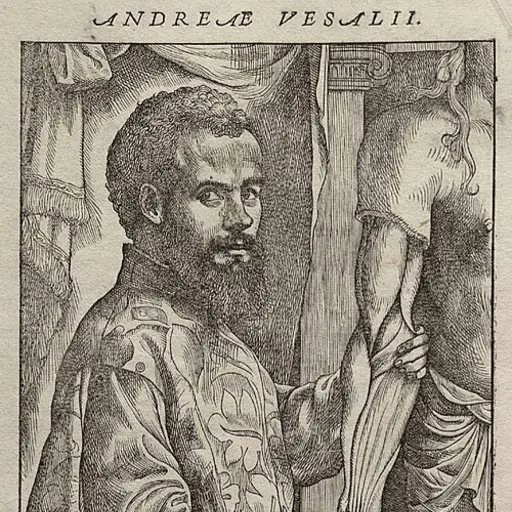

Dissected human bodies himself to correct the errors of ancient medicine, producing a monumental work of anatomy.
Life
Studies in Paris
Vesalius was born in Brussels into a family of court physicians and studied medicine in Leuven and then Paris. At the time, anatomy lectures were mostly given by professors reading from the textbook while assistants did the actual cutting, and the textbooks still followed the accounts of the ancient Roman physician Galen, which were based on animal dissection and often differed from the actual structure of the human body.
On the Fabric of the Human Body
After moving to teach at the University of Padua, he insisted on dissecting corpses himself while lecturing on the spot, collecting the bodies of executed criminals to verify his findings again and again. In 1543 he published On the Fabric of the Human Body, with finely detailed woodcut illustrations, pointing out more than two hundred errors in Galen. In the same year Copernicus's work setting out heliocentrism also happened to appear, making it a landmark year in the history of science.
Court physician
The book sparked fierce debate in the medical world, with many conservative physicians insisting that Galen was infallible, and for a time he grew disheartened and became a court physician instead. Later generations often simply cast him as a lone hero defying authority, but in fact he retained part of Galen's framework and corrected it step by step through empirical evidence. His death from illness during a pilgrimage in his later years is also surrounded by legend, and the details are hard to verify.
Legacy
Vesalius replaced blind deference to ancient authority with hands-on dissection and precise anatomical plates, and is widely recognized as the founder of modern anatomy. The illustrations in On the Fabric of the Human Body combine scientific and artistic value and influenced medical teaching for centuries. He did not fully break free of Galen's physiological framework, but his empirical method paved the way for later breakthroughs such as Harvey's discovery of the circulation of the blood. The book appeared in the same year as Copernicus's work, and 1543 is often seen as a symbolic year of the Scientific Revolution.
Major works & achievements
- Published On the Fabric of the Human Body in 1543
- In the same year published the Epitome for students
- Insisted on dissecting and lecturing in person
- Exposed many errors in Galen's anatomy
Did you know? The woodcut illustrations in On the Fabric of the Human Body are generally attributed to Titian's workshop; another view holds that they were mainly drawn by the painter Jan van Calcar.
Key dates
- 1533Went to Paris to study medicine
- 1537Became professor of Anatomy at the University of Padua
- 1540Publicly demonstrated human dissection, challenging Galen's teachings
- 1543Published On the Fabric of the Human Body
- 1544Became Court physician to the Holy Roman Empire
- 1559Served as physician at the Spanish court
- 1564Died while on Pilgrimage