Henry VIII
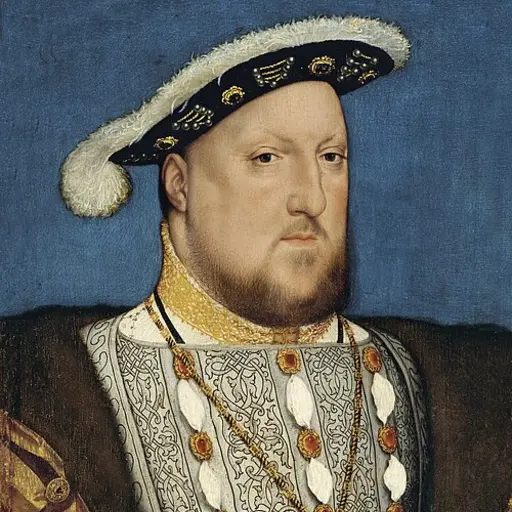

Broke with the papacy over his divorce case and founded the Church of England.
Life
Renaissance monarch
Henry VIII was the second monarch of the Tudor dynasty, and in his youth was cast as a model Renaissance monarch, learned in theology and physically robust. For many years his marriage to Catherine of Aragon produced no surviving son, and the question of an heir was then seen as a paramount matter for the dynasty's survival and the stability of the realm.
Break with Rome
When the papacy refused to approve his divorce from Catherine, he enacted the Act of Supremacy in 1534, making himself Supreme Head of the Church of England, dissolving the monasteries across the country and granting their confiscated lands to his favorites. He married six times and had two queens executed; doctrinally he retained most Catholic rites, breaking completely with Rome only over the governance of the church.
Achievements, faults and legacy
Later generations often reduce the English Reformation to "a king founding a church to get a divorce," but behind it also lay the crown's financial straits, the great lure of monastic lands, and the rise of ideas of a national church. In his later years he grew obese and violent-tempered, executing two queens and several senior ministers; his reign laid the institutional foundation on which his daughter Elizabeth I later consolidated a Protestant England.
Legacy
Through his break with Rome, Henry VIII separated the Church of England from the papacy, strengthening royal power as never before and opening the way for England's later turn to Protestantism. He expanded the navy and integrated Wales, advancing the formation of the modern state. Yet his autocracy, his execution of dissidents and the social upheaval caused by the dissolution of the monasteries were equally enormous. His six marriages have made him one of the best-known English monarchs, and his image is often dramatized.
Major works & achievements
- Issued the Act of Supremacy in 1534
- Dissolved the monasteries and confiscated church property
- Expanded the English Royal Navy
- Annexed Wales to England by statute
Did you know? His three children, Edward VI, Mary I and Elizabeth I, succeeded to the throne one after another, and none of them left heirs.
Key dates
- 1509Became King of England
- 1521Granted the title "Defender of the Faith" by the Pope
- 1533Marriage to Catherine of Aragon declared void
- 1534Enacted the Act of Supremacy, founding the Church of England
- 1536Began dissolving the monasteries
- 1536Executed Queen Anne Boleyn
- 1542Executed Queen Catherine Howard
- 1547Died