Hürrem Sultan
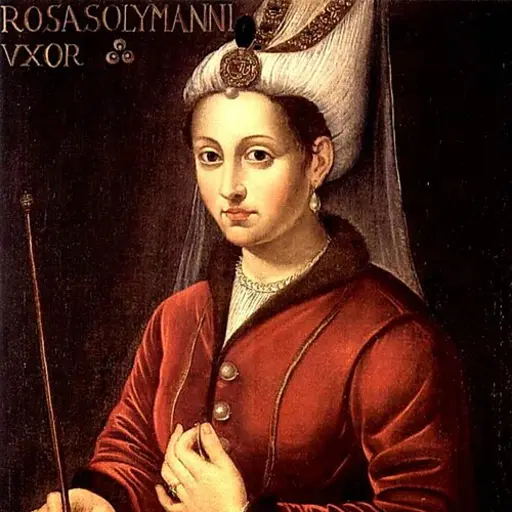

Rose from slave to empress and became deeply involved in Ottoman affairs of state.
Life
From slave girl to favorite consort
Hürrem was, by one account, the daughter of an Eastern Orthodox priest in Ukraine; captured and enslaved in a Crimean Tatar raid, she eventually entered the harem of Suleiman the Magnificent. By Ottoman court custom each of the sultan's sons went out with his mother to govern a province for experience, and harem women generally did not take part in affairs of state.
Empress and state affairs
With her intelligence and Suleiman's favor she stood out, and was, unusually, formally made his empress. She led the sultan to break the old custom of keeping concubines in separate households, lived permanently in the palace, took part in state affairs through correspondence, and funded public buildings such as mosques, soup kitchens and caravanserais; she is also believed to have helped bring about the killing of Suleiman's eldest son in the struggle over the succession.
Contested image
Later Western writings often used the name "Roxelana" to paint a negative image of her as a manipulator of government, a classic case of "harem interference in politics"; Ottoman sources give a more complex assessment, presenting her as both a philanthropist and a political participant. Her exact year of birth remains undetermined owing to the lack of early records, and historians can usually give only an approximate range.
Legacy
Hürrem rose from slave girl to formal wife of the sultan, breaking the custom that a favorite consort must accompany her son to his provincial post, and became a precursor of the harem's involvement in politics during the later so-called "Sultanate of Women." Western sources and later novels often portray her as a schemer who manipulated the sultan and plotted against the princes, but most of these accusations lack firm proof; modern research places more weight on her charitable works and political letters, and assessments of her have become more multifaceted.
Major works & achievements
- Formally made Empress by Suleiman the Magnificent
- Built the Haseki Sultan Complex in Istanbul
- Funded a soup kitchen in Jerusalem
- Letters with Sulayman survive
Did you know? Her daughter Mihrimah was also a famous patron of architecture, and Sinan built two mosques for her.
Key dates
- 1520Became favorite after Suleiman the Magnificent's accession
- 1533Made Empress in a royal wedding
- 1541Built a mosque and Charity complex
- 1553Suleiman's eldest son Mustafa Executed
- 1558Died in Istanbul