Michelangelo Buonarroti
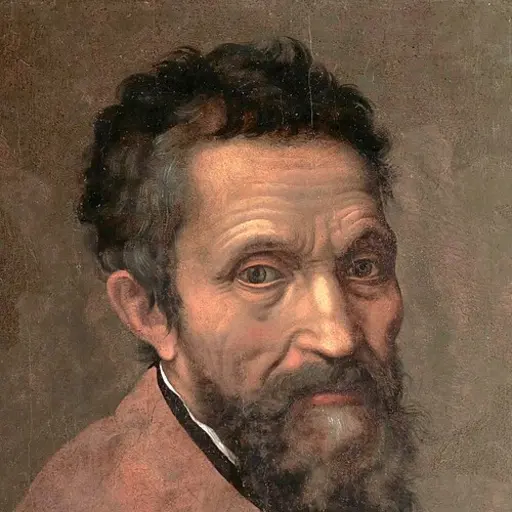

Painted the Sistine ceiling single-handedly and excelled at sculpture, painting and architecture alike.
Life
Under the Medici
Michelangelo Buonarroti was born in Caprese near Florence, the son of a small-town official. As a youth he apprenticed in Ghirlandaio's workshop and won the favor of the Medici family, studying human proportions in a garden filled with their collection of classical sculpture. At the time, humanism and the classical revival were flourishing in Florence under Medici patronage, and the status of artists rose accordingly.
David and the dome
From 1501 to 1504 he carved the marble statue David in Florence, proclaiming the confidence of the republican city-state. In 1508 Pope Julius II commissioned him to paint the ceiling of the Sistine Chapel on his own, and he spent four years completing the Genesis cycle of frescoes. In his later years he was also put in charge of designing the dome of St. Peter's Basilica, establishing its final form.
The aloof master
He insisted on carrying out large projects alone or with only a handful of assistants, unlike the prevailing workshop practice of dividing labor. Solitary by temperament, he repeatedly clashed with popes and patrons. Later generations often imagine the Sistine ceiling frescoes as effortlessly dashed off, but in fact he completed them over years lying on his back on scaffolding with paint dripping onto his face, and he always considered himself first and foremost a sculptor.
Legacy
Michelangelo Buonarroti reached the summit of the Renaissance in the three fields of sculpture, painting and architecture, and his expression of physical power and spiritual tension in the human body directly inspired Mannerism and Baroque art. His contemporary Vasari held him up in his Lives of the Artists as the supreme model of art, and he thus became an artist whose biography appeared during his own lifetime. His stubborn, solitary personality and his conflicts with his patrons shaped the later image of the "genius artist."
Major works & achievements
- Statue: Pietà
- Marble statue: David
- Sistine Chapel ceiling
- The Last Judgment, the altar fresco of the Sistine Chapel
- Designed the dome of St. Peter's Basilica
Did you know? The Pietà is the only work he ever signed, with his name carved on the sash across the Virgin's chest.
Key dates
- 1488Apprenticed in Ghirlandaio's workshop
- 1496First trip to Rome
- 1501Returned to Florence to carve the David
- 1504The David unveiled
- 1508Commissioned to paint the Sistine ceiling
- 1512Ceiling frescoes completed
- 1534Settled in Rome
- 1547Directs work on St. Peter's Basilica Dome
- 1564Died in Rome