Leonardo da Vinci
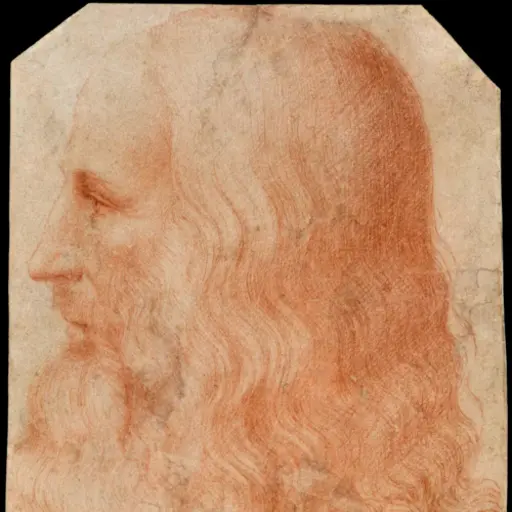

Excelled at both painting and engineering studies; seen as the archetypal Renaissance polymath.
Life
Boy from Vinci
Leonardo was born in the town of Vinci near Florence, the illegitimate son of a notary and a peasant woman, and so was barred from a university education; at fourteen he was apprenticed in Verrocchio's workshop. Florence at the time teemed with workshops under the patronage of the Medici family, and it was normal for painters to be versed in metalwork, mechanics and anatomy as well.
Courts and notebooks
He served in turn the Sforza court in Milan, the Republic of Florence and the King of France, painting works such as The Last Supper and the Mona Lisa and pioneering the sfumato technique. He also left behind tens of thousands of pages of notebooks covering human anatomy, bird flight, hydraulic engineering, optics and military devices, meticulously observed but mostly never put into practice.
Reputation as a polymath
He habitually procrastinated and finished few works, and his reputation in his lifetime came mainly from courts and fellow artists. His notebooks long lay scattered and unpublished, so they had limited influence on the science of his day and were not fully appreciated until they were compiled in modern times. He is seen as the archetypal Renaissance polymath, and his cross-disciplinary method of observation is still widely discussed today.
Legacy
Leonardo da Vinci is the symbol of the Renaissance ideal of the polymath. The sfumato, aerial perspective and psychological portrayal of figures he developed profoundly influenced later European painting. His notebooks reveal keen observation of anatomy, mechanics, flowing water and flight, but because they were not published in his lifetime, their influence on the science of his day was limited. The modern deification of him also often exaggerates his "inventions"; many of his designs never went beyond the conceptual stage.
Major works & achievements
- The Last Supper
- Mona Lisa
- Drawing: Vitruvian Man
- Over 10,000 pages of scientific and engineering notebooks
Did you know? The Mona Lisa was stolen from the Louvre in 1911 and was recovered in Florence only two years later.
Key dates
- 1466Apprenticed in Verrocchio's workshop
- 1482Invited to the court of Milan
- 1495Began painting The Last Supper
- 1500Returned to Florence
- 1503Began painting the Mona Lisa
- 1506Returns to Milan; focuses on anatomy and hydraulics
- 1513Went to Rome
- 1516Moved to Amboise at the French king's invitation
- 1519Died in France