Gu Yanwu
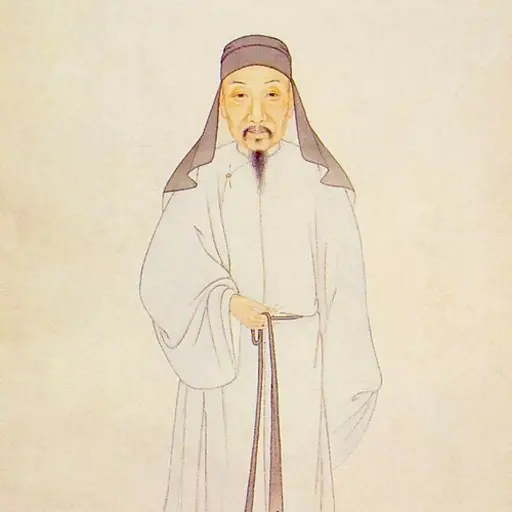

Declared that "everyone bears responsibility for the rise and fall of the realm" and set the tone of Qing evidential scholarship.
Life
Ming loyalist of Kunshan
Gu Yanwu was from Kunshan, Jiangsu, and came from a scholarly family. As a youth he took part in the activities of the Restoration Society, and during the Ming-Qing transition he took part in resistance to the Qing in Jiangnan. After its failure he never served the Qing for the rest of his life, regarding himself as a Ming loyalist, and spent many years traveling across North China studying its geography and economic conditions.
Practical statecraft
Reflecting on the late Ming fashion of empty talk about mind and nature, he advocated "practical statecraft," carried out wide-ranging critical study of the classics and histories, phonology, geography and institutions, and wrote works such as Rizhi Lu (Record of Daily Knowledge) and Tianxia Junguo Libing Shu (Strengths and Weaknesses of the Provinces of the Realm). He championed down-to-earth empirical methods and distinguished "preserving the state" from "preserving the realm," an idea later summed up as "everyone bears responsibility for the rise and fall of the realm."
Refused to serve the Qing
He refused summons from the Qing dynasty all his life and repeatedly declined recommendations to the special boxue hongci examination, yet he also kept up personal friendships with some Qing officials, and his later life was not entirely cut off from the Qing court, which stands in tension with his strong image as a Ming loyalist. The evidential methods he pioneered directly influenced the Qian-Jia school, and he is regarded as one of the forerunners of Qing "plain learning" (puxue).
Legacy
Gu Yanwu, together with Huang Zongxi and Wang Fuzhi, is counted among the three great thinkers of the late Ming and early Qing. He criticized empty talk about mind and nature and advocated broad learning, empirical evidence and practical statecraft, opening the Qing tradition of evidential scholarship; he is regarded as a forerunner of the Qianlong–Jiaqing school. His argument that responsibility for "preserving all under Heaven" lies with every ordinary man was widely quoted during the national crises of modern times. Some scholars, however, believe that later evidential scholarship departed from his aim of practical statecraft and became purely academic.
Major works & achievements
- Rizhi Lu (Record of Daily Knowledge)
- Tianxia Junguo Libing Shu (Strengths and Weaknesses of the Provinces of the Realm)
- Yinxue Wushu (Five Books on Phonology)
- Distinguished "the fall of a state" from "the fall of all under heaven"
Did you know? The eight-character phrase "The rise and fall of the realm is the responsibility of every common man" is not his own wording; Liang Qichao condensed it from the Rizhi Lu (Record of Daily Knowledge).
Key dates
- 1633Joined the Restoration Society
- 1645Took part in Resistance to the Qing in Jiangnan
- 1657Began traveling north to survey
- 1662Completed the first draft of Tianxia Junguo Libing Shu (Strengths and Weaknesses of the Provinces of the Realm)
- 1670Rizhi Lu (Record of Daily Knowledge) published in installments
- 1679Declined nomination for the boxue hongci examination
- 1682Died in Quwo, Shanxi