Yelü Chucai
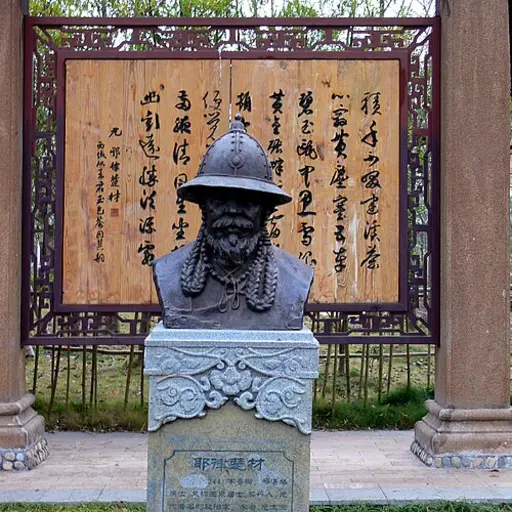

A descendant of the Khitan imperial house who became a senior minister of the Mongols, he championed civil governance to preserve the population of the Central Plains.
Life
Descendant of the Liao royal house
Yelü Chucai was a descendant of the Yelü clan, the imperial house of the Liao dynasty, and his family served as officials under the Jin dynasty. He was widely learned in the classics and histories, astronomy, calendrical science and Buddhism. On the eve of the Jin dynasty's fall, Genghis Khan took Yanjing and summoned him into his service as an adviser, after which he long followed the Mongol court, assisting in state affairs.
Advising Government and Building Institutions
During Genghis Khan's Western Campaign against Khwarazm he served as an adviser with the army, repeatedly winning trust through his expertise in astronomy and calendrical calculation. After Ögedei succeeded to the khanship in 1229, Yelü Chucai was given heavy responsibilities. He pushed to implement a taxation system and set up tax bureaus, opposed proposals to turn the farmlands of the Central Plains into pasture, advocated preserving the registered population and governing the newly conquered Central Plains through civil administration, and promoted the revival of the civil service examinations and the founding of an office to compile and edit classical texts.
Losing Influence in Later Years
Yelü Chucai played a key role as the Mongol Empire shifted from pure military conquest to establishing stable rule, and later generations regarded him as a classic example of "transforming the barbarians through Chinese civilization." In his later years, however, his actual influence at court had greatly waned; he was gradually pushed aside by other bureaucratic factions, and after his death he was even falsely accused for a time and his family property confiscated. This stands in stark contrast to his image as a highly trusted minister in his early years, and this late fall from favor is often overlooked in simplified historical accounts.
Legacy
Yelü Chucai is regarded as an important driving force in the Mongol Empire's shift from plundering conquest to institutionalized rule. He argued for preserving the population of the Central Plains and replacing slaughter and pillage with taxation, which helped lessen the war's destruction of northern society. His actual power, however, was limited, and many of his proposals were never fully carried out; from Ögedei's later years he was sidelined by Abd al-Rahman and others, and his influence waned. Later historians' assessments of him are mainly positive.
Major works & achievements
- Joined Genghis Khan's western campaign, advising on military and civil affairs
- Sets up tax bureaus in ten circuits, establishing a taxation system
- Dissuaded turning farmland of the Central Plains into pasture
- Promotes the Wuxu examination to select Confucian scholars
- Wrote Record of a Journey to the West
Did you know? While in Yanjing he spent three years practicing Chan under Wansong Xingxiu, taking the Buddhist name Layman Zhanran.
Key dates
- 1190Born in Yanjing
- 1215Summoned into service by Genghis Khan
- 1219Joined the Western Campaign against Khwarazm
- 1229Ögedei takes the throne and gives him heavy responsibilities
- 1230Introduced a taxation system
- 1236Restored the imperial examinations
- 1244Died