Jayavarman VII
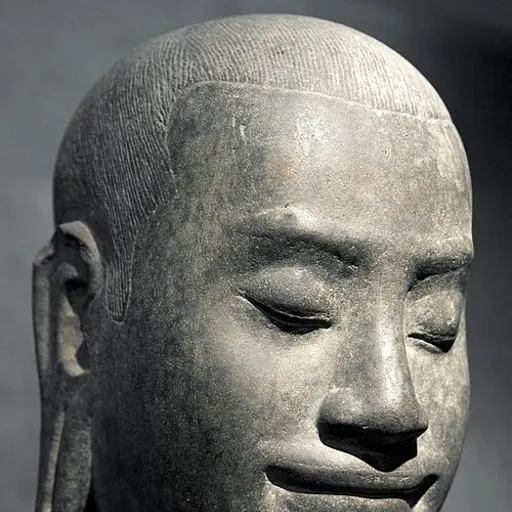

After repelling a Cham invasion he took the throne and launched vast building projects, completing Angkor Thom and the Bayon.
Life
Exile and Restoring the State
Jayavarman VII was born into the Khmer royal family and spent many years in exile in Champa in his youth. In 1177 a Cham fleet made a surprise attack on the Khmer capital at Angkor, killed the reigning Khmer king and occupied the capital for a time. Jayavarman organized an army to counterattack and finally drove out the Cham forces in 1181; after recapturing the capital he was crowned king, at a time when the Khmer realm was rebuilding after a devastating foreign blow.
Great Building Works
He then launched building works on an unprecedented scale, constructing the new capital of Angkor Thom, whose signature monument is the Bayon, famous for its massive stone towers bearing four-faced Buddha images. He also built many other Buddhist temples such as Ta Prohm and Preah Khan, and established a network of roads, rest houses and hospitals across the country; according to inscriptions, the hospitals numbered over a hundred. A devout follower of Mahayana Buddhism, he broke with the long-standing Khmer royal tradition of worshipping the Hindu god Shiva.
Zenith and Its Cost
The scale of construction under Jayavarman VII is regarded as the peak of the Khmer Empire, but the enormous projects and frequent foreign wars also greatly drained the state's resources, and the empire began to decline soon after his death. The giant smiling stone faces on the Bayon's towers are often read by modern tourists as the "Khmer smile," a symbol of compassion, but this is largely a poetic label applied by later generations, and scholars still differ over their precise religious and political meaning.
Legacy
Jayavarman VII is regarded by many Cambodians as their greatest king. He rebuilt the state after a devastating foreign attack, built on a scale exceeding any earlier Khmer monarch, and expressed the Buddhist ideal of compassion through hospitals, rest houses and other facilities. But his massive building programs and the conquest of Champa consumed enormous manpower and resources, and some scholars believe this hastened Angkor's later decline. After his death the Khmer royal family turned back to Hinduism, and some Buddhist images were destroyed.
Major works & achievements
- 1181: Drives back Champa and recaptures the capital
- Built Angkor Thom and the Bayon
- Built Ta Prohm and Preah Khan
- Built hospitals and rest houses across the realm
- Sent armies to conquer Champa
Did you know? A stone portrait head of him is now held in the National Museum of Cambodia and is a masterpiece of Khmer sculpture.
Key dates
- 1122Born into the Khmer Royal family
- 1160Spent years in Exile in Champa
- 1177Champa raids the capital; the king is killed
- 1181Repels Champa and becomes king
- 1186Built Ta Prohm
- 1191Began building the Bayon
- 1200Angkor Thom largely completed
- 1218Died