Hildegard von Bingen
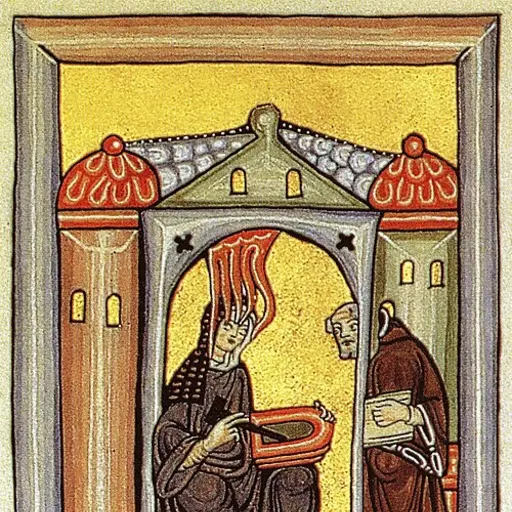

She founded a convent, was versed in theology, medicine and music, and produced works spanning many fields.
Life
Enclosed as a Child
Hildegard came from a Rhineland noble family. Sickly as a child, she said she often had visions. At the age of eight her family sent her to be educated in the anchorite cell attached to the monastery of Disibodenberg; as an adult she joined the Benedictines, and through her ability and reputation gradually became head of the community.
Visions and Writings
In her forties she began recording the religious visions she had long experienced, and with the church's approval wrote theological works such as Scivias. She also composed a large body of sacred music still performed today and wrote works of medicine and natural history on herbs, minerals and human pathology—a breadth extremely rare among the monks and nuns of her time. Around 1150, overcoming obstruction from her monastic superiors, she founded a separate convent at Rupertsberg with herself as abbess, gaining a considerable degree of independence.
Doctor of the Church and Misreadings
Hildegard is one of the few medieval women to leave a large body of original writings and musical works. Since the late 20th century her music and natural history writings have attracted wide renewed attention, and in 2012 the pope proclaimed her a Doctor of the Church. It should be noted that some modern popular accounts cast her as a "feminist pioneer" or a symbol of "alternative medicine" free from the limits of her age; this is largely a projection of contemporary perspectives, and her own thought and practice remained firmly rooted in the framework of medieval Christian theology.
Legacy
Hildegard was one of the most creative women of the Middle Ages. She is among the identifiable medieval composers with the largest surviving body of work, and her writings on theology, medicine and natural history also show wide learning. She corresponded with popes and emperors and publicly undertook preaching tours, enjoying rare influence in a male-dominated church. In 2012 she was canonized as a saint and named a Doctor of the Church. Modern popular interpretations of her sometimes detach her from her theological context and should be treated with caution.
Major works & achievements
- Scivias
- Musical drama Ordo Virtutum
- Medical work Causae et Curae
- Founded Rupertsberg Monastery
Did you know? She created an "unknown language" of about a thousand words, complete with its own alphabet.
Key dates
- 1098Born into a Rhineland noble family
- 1106Entered the hermitage at Disibodenberg
- 1136Became head of the convent
- 1141Began recording her religious Visions
- 1151Founded Rupertsberg Monastery
- 1158Wrote works on medicine and natural history
- 1179Died