Yue Fei
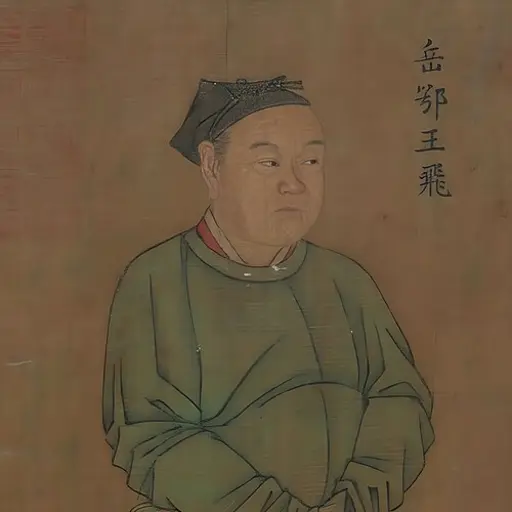

Led the Yue Family Army to repeated victories over the Jin, but was framed by Qin Hui for advocating war and died wrongfully in prison.
Life
Rise of the Yue Family Army
Yue Fei came from a farming family in Xiangzhou. From childhood he practiced martial arts and loved reading military texts. At the end of the Northern Song he joined the army to resist the Jin, lived through the turmoil of the Jingkang Incident and the Song court's flight south, and rose step by step through battlefield merit in those chaotic times. He built the "Yue Family Army," famed for strict discipline and for never harming civilians, which repeatedly repelled Jin invasions in the Huai and Jing–Xiang regions and won the deep support of soldiers and civilians.
Northern Expedition and Wrongful Imprisonment
In 1140 the Jin general Wanyan Zongbi launched a major advance south. Yue Fei's army won successive victories at Yancheng and Yingchang and at one point reached Zhuxianzhen, closing in on Kaifeng; morale soared, and he urged pressing north after the victory to recapture the Central Plains. But Emperor Gaozong of Song and chancellor Qin Hui favored peace talks and, within a single day, sent twelve golden tablets ordering him urgently to withdraw. Yue Fei was then stripped of his command, and in 1142 he was killed in the prison of the Court of Judicial Review in Lin'an on the charge of "perhaps there was."
Posthumous Image
Twenty years after Yue Fei's death, Emperor Xiaozong of Song rehabilitated him and posthumously made him Prince of E. His image of serving the country with utmost loyalty was continually shaped and magnified by later generations; widely known episodes such as "his mother tattooing his back" come mostly from later storytelling scripts and operas rather than rigorous historical records. His opposition to Qin Hui has also been simplified into a moral parable of loyalty versus treachery, obscuring the complex background of the struggle within the Southern Song court between the pro-war and pro-peace lines.
Legacy
Yue Fei is the most famous general in Chinese history to have fought against the Jin and has been revered by later generations as the embodiment of loyalty and righteousness; in the early Republic of China he was worshiped together with Guan Yu in "Guan-Yue temples." His wrongful death reflects the Southern Song court's choice between war and peace, and the responsibility of Emperor Gaozong of Song in it is still much discussed. His image was continually reshaped by storytellers' scripts and opera and departs to some degree from the historical record; whether he wrote "Man Jiang Hong" is also disputed. But his spirit of resisting the enemy and defending the country has had a profound influence on Chinese popular culture.
Major works & achievements
- Formed the strictly disciplined Yue Family Army
- Recovered the six prefectures of Xiangyang in 1134
- Great victories at Yancheng and Yingchang in 1140
- Traditionally regarded as the author of "Man Jiang Hong: My Hair Bristles with Rage"
Did you know? Before Yue Fei's tomb at the Temple of Yue Fei beside West Lake in Hangzhou kneel iron statues of four people, including Qin Hui.
Key dates
- 1103Born in Tangyin, Xiangzhou
- 1122Enlisted to fight the Liao and Jin
- 1130Recaptured Jiankang; his reputation began to grow
- 1136Led a Northern Expedition and recaptured some lost territory
- 1140Great victories at Yancheng and Yingchang; closed in on Kaifeng
- 1141Recalled to Lin'an by twelve gold-lacquered tablets
- 1142Killed on a "Perhaps there was" charge