Zhuangzi
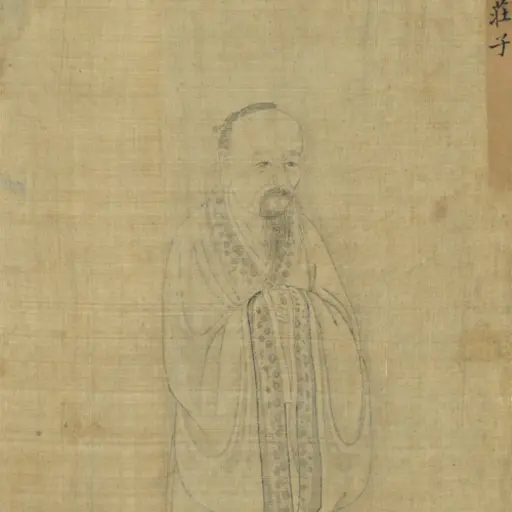

Challenged the pursuit of fame and debates over right and wrong with his ideas of the equality of things and free wandering.
Life
Minor official of the lacquer garden
Zhuangzi was born at Meng in the State of Song and for a time served as a petty official in charge of a lacquer-tree garden, but soon tired of officialdom, resigned and withdrew into seclusion. In the mid-Warring States period in which he lived, the states fought without end and scholars were eager to lobby rulers in pursuit of fame and office, but he went the other way and chose to stay far from the centers of power.
Equality of things and free wandering
He often debated with his close friend Hui Shi; their argument while watching fish from the bridge over the Hao River—"You are not a fish, so how do you know the fish are happy?"—has been handed down through the ages. He held that all things are equal and that right and wrong are relative, sought the spiritual freedom of "free and easy wandering," and in the parable of dreaming he had become a butterfly, unable to tell whether Zhuang Zhou had dreamed he was a butterfly or a butterfly was dreaming it was Zhuang Zhou, expressed his doubt about the fixed boundaries of the self.
Declined to be chief minister and wrote his book
The King of Chu once sent envoys with rich gifts to invite him to become chancellor; he politely declined, saying he would rather be a turtle dragging its tail freely in the mud. This anecdote is often cited as proof of his indifference to fame and gain, but some scholars point out that apart from the Inner Chapters, the Miscellaneous and Outer Chapters of the Zhuangzi were very likely written by later followers and do not necessarily all reflect Zhuang Zhou's own thought; the style and positions in the book are not entirely consistent.
Legacy
Zhuangzi expounded Daoist thought through dazzling parables and a vast, unrestrained prose style; paired with Laozi as "Lao-Zhuang," he stands as a twin peak of Chinese philosophy and literature. His relativism and pursuit of spiritual freedom profoundly influenced Wei-Jin Xuanxue (Neo-Daoism), Chan Buddhism, and the aesthetics and outlook on life of literati through the ages. Some criticize his thought as passive and escapist, but more scholars see it as a profound reflection on power, utilitarianism and prejudice, and his literary achievement has long been hailed as the finest prose of the pre-Qin era.
Major works & achievements
- The seven Inner Chapters of the Zhuangzi (generally attributed to Zhuangzi himself)
- Free and Easy Wandering; On the Equality of Things
- Parables such as "Zhuang Zhou dreams of a butterfly" and "the debate on the Hao River bridge"
- Paired with Laozi as "Lao-Zhuang"
Did you know? During the Tianbao era, Emperor Xuanzong of Tang conferred on Zhuangzi the title "Perfected Man of Nanhua," and the book Zhuangzi was accordingly honored as the True Classic of Nanhua.
Key dates
- 369 BCEBorn at Meng in the State of Song
- 340 BCEServed as an official of the lacquer garden and soon resigned from office
- 320 BCEDebated "the joy of fish" with Hui Shi on the bridge over the Hao
- 310 BCEWrote on the equality of things and free and easy wandering
- 286 BCEDied c. the time Song was destroyed by Qi