Chandragupta Maurya
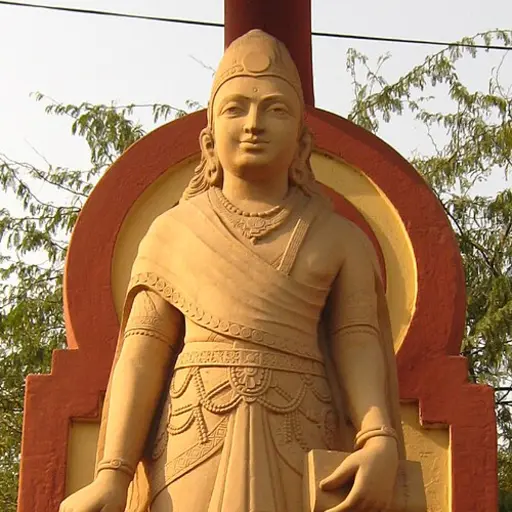

Overthrew the Nanda dynasty and founded India's first unified empire.
Life
Rose from humble origins
Chandragupta Maurya's origins are unclear; he is said to have come from humble beginnings. As a young man he met Kautilya (also called Chanakya), a Brahmin strategist versed in statecraft and political strategy, and the two joined forces to overthrow the unpopular Nanda dynasty in the Ganges basin, founding the Maurya Empire, the first in Indian history to unify most of the subcontinent.
Unified northern India
He made Pataliputra his capital and built a centralized bureaucracy based on the institutions described in the Arthashastra, along with an intelligence network spanning the country. After the death of Alexander the Great, he also repelled Seleucid forces attempting to retake the Indus valley, gained territory around Afghanistan through a treaty, and sealed an alliance with Seleucus through a marriage.
Jain tradition
According to Jain legend, in his later years he passed the throne to his son Bindusara, went south with Jain monks to Shravanabelagola in the Mysore region, and fasted to death in pursuit of liberation. This account appears only in Jain sources and is not recorded in Brahmanical or Buddhist texts, so its authenticity has long been doubted, but it also indirectly suggests that he did turn to the ascetic tradition in his later years.
Legacy
Chandragupta Maurya founded the first empire in Indian history to unify almost all of the northern subcontinent, and his grandson Ashoka built on this to bring the Maurya Empire to its zenith. Surviving fragments of the Greek envoy Megasthenes' Indica preserve his observations of Pataliputra at the time and are an important external source for the period. However, his origins, his relationship with Kautilya and his final years rest largely on later legend, and the date of the Arthashastra is also disputed, so the details of his life must still be treated with caution.
Major works & achievements
- Overthrew the Nanda dynasty and founded the Maurya Empire
- Repelled Seleucus and gained the lands west of the Indus
- Built a centralized bureaucracy and intelligence system
- Made peace and a marriage alliance with Seleucus
Did you know? Greek sources call him "Sandrocottus"; according to Strabo, he gave 500 war elephants in exchange for peace with Seleucus.
Key dates
- 340 BCEBorn c. in northern India
- 325 BCEMet the strategist Kautilya
- 321 BCEOverthrew the Nanda dynasty and founded the Maurya Empire
- 305 BCERepelled the Seleucid invasion and fixed the western frontier
- 297 BCEPassed the throne to his son, converted to Jainism and renounced the world