Wang Mang
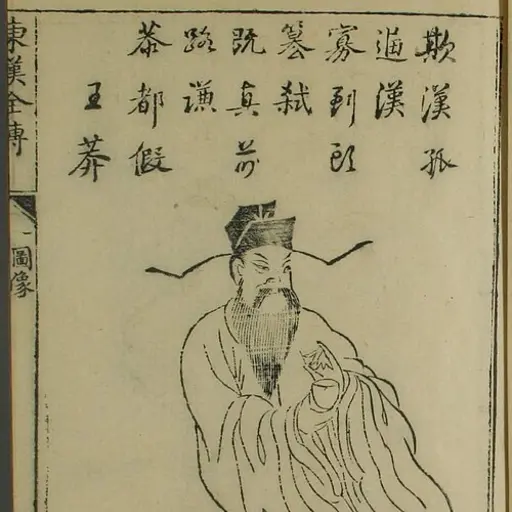

An imperial in-law who usurped the Han throne; his restoration of ancient institutions ended in great turmoil.
Life
Humble Imperial in-law
Wang Mang came from the Wang clan, the family of the empress of Emperor Yuan of Han. His branch of the family fell on hard times when he was young, but he became known for his modesty, love of learning and devotion to his mother and widowed sister-in-law, in sharp contrast to the other arrogant and extravagant Wang sons, and so built up an extremely high reputation at court and in the country.
Replaced Han and reformed the system
He held high offices such as Grand Marshal, gradually eliminating opponents and seizing real power; in 9 CE, with Emperor Ping of Han dead and Ruzi Ying still a child, he formally abolished the Han and founded the "Xin" dynasty. He then carried out sweeping reforms modeled on antiquity, declaring all land state property, banning the buying and selling of slaves and repeatedly reforming the currency, in an attempt to rebuild an ideal order on the model of the Rites of Zhou.
Fall of the Xin dynasty
These hasty and idealistic reforms disrupted the normal economic order, and together with widespread famine caused by the Yellow River changing course, they provoked large-scale uprisings such as the Lulin and the Red Eyebrows. In 23 CE Chang'an fell, and he was killed in the chaos. Traditional histories mostly portray him simply as a usurping "arch-villain," but since modern times some scholars have pointed out that the problems he tried to solve, land concentration and the gap between rich and poor, were real; it was just that his methods of reform were too radical and divorced from reality.
Legacy
Wang Mang is one of the most polarizing figures in Chinese history. Traditional historians saw him as a "usurper of the Han," and Bai Juyi wrote the line "Wang Mang was humble and respectful before he usurped the throne" to mock his hypocrisy; in modern times Hu Shih, by contrast, called him "a socialist of 1,900 years ago," stressing the idealism of his land and slave reforms. The view more common among scholars today is that the problems he faced, such as the concentration of landholding, were genuinely serious, but his reforms were divorced from reality and constantly changed, and together with frequent natural disasters they ultimately led to the collapse of social order.
Major works & achievements
- Replaced the Han and founded the Xin dynasty (9–23 CE)
- Introduced the King's Land system, banning the sale and purchase of land and slaves
- Introduced the "five equalizations and six monopolies," placing key trades under state control
- Reformed the currency several times, casting knife-shaped and spade-shaped coins
Did you know? The "gold-inlaid knife" coins cast under Wang Mang are exquisitely crafted and have long been prized by coin collectors.
Key dates
- 45 BCEBorn into the Wang clan, imperial in-laws of the Han
- 8 BCEServed as Grand Marshal and regent
- 1Given the title "Duke Who Secures the Han," holding real power
- 9Supplanted the Han and proclaimed himself emperor, renaming the state Xin
- 9Introduced the King's Land system and currency reform
- 17Red Eyebrows, Lulin and other uprisings broke out one after another
- 23Chang'an fell; killed in the melee