Seneca the Younger
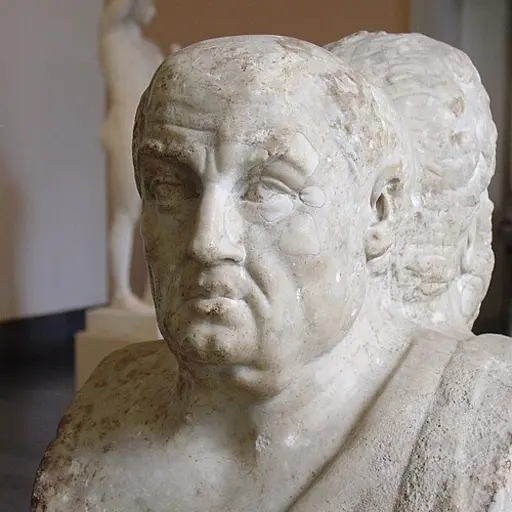

Tutor of Nero who preached moderation but died after being drawn into court politics.
Life
Talent of Córdoba
Seneca was born in Córdoba in the Roman province of Spain; his father was a famous rhetorician. He went to Rome to study as a boy and embraced the Stoic way of self-discipline and moderation. In the age of the Julio-Claudian dynasty in which he lived, court power struggles often coexisted with the public image of philosophical cultivation.
Exile and regency
In 41 CE he was accused of adultery with a woman of the imperial family and exiled to Corsica; eight years later he was recalled to become the teacher of the young Nero. After Nero came to the throne, Seneca and the Praetorian prefect Burrus jointly guided the government, keeping it relatively well ordered for a time, while he wrote many ethical works such as On Mercy and his collected letters, expounding Stoic ideas such as moderation and facing death calmly.
Ordered to die, and controversy
As Nero grew increasingly tyrannical, Seneca was gradually pushed aside, and in 65 CE he was implicated in the Pisonian conspiracy; Nero ordered him to die, and he calmly opened his veins, a scene Tacitus described in detail as a model of Stoic martyrdom. Later generations have often questioned the gap between his words and deeds—preaching poverty and moderation while amassing enormous wealth through moneylending and imperial favor—and this contradiction remains the focus of debate about him to this day.
Legacy
Seneca the Younger is one of the most important representatives of Roman Stoic philosophy. His ethical prose is plainly written and explores questions of life such as anger, death and time; from the Renaissance onward he was greatly admired by thinkers such as Montaigne, and his tragedies also influenced Elizabethan English drama. But as a senior minister of Nero, he is accused of drafting the document justifying Nero's murder of his mother, and the contrast between his vast wealth and his sermons on poverty has drawn much criticism; judgments of his character remain contested to this day.
Major works & achievements
- Moral Letters to Lucilius
- On Mercy, On Anger, On the Shortness of Life
- Tragedies such as Medea and Oedipus
- Together with Burrus, guided the government in the early years of Nero's reign
Did you know? The "Correspondence of Seneca and Paul" that circulated in the Middle Ages comprises fourteen letters, later shown to be a 4th-century forgery.
Key dates
- 4 BCEBorn in Córdoba, Spain
- 41Exiled to Corsica by Claudius
- 49Recalled to Rome to become Nero's tutor
- 54Nero took the throne; he became a chief adviser to the government
- 62Gradually lost Nero's trust and withdrew from public life
- 65Accused of taking part in a conspiracy; ordered to take his own life