Su Wu
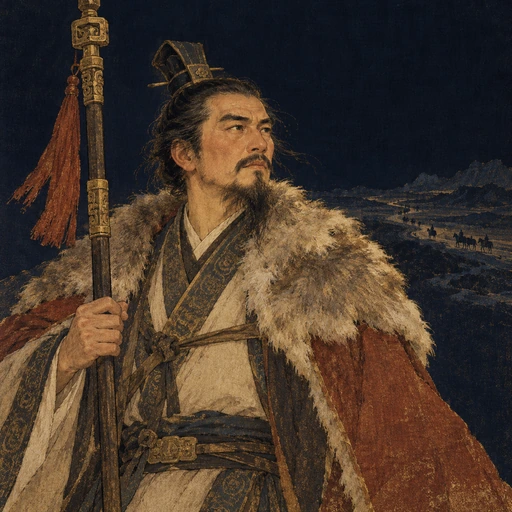
Sent as envoy to the Xiongnu, he was detained for 19 years, herding sheep by Lake Baikal while holding his staff unbowed.
Life
Detained as an envoy
In 100 BCE Su Wu went as envoy to the Xiongnu with the rank of general of the palace gentlemen. Because his deputy became entangled in a plot within the Xiongnu, he was detained by the chanyu. The chanyu pressed him to surrender; when he refused, he was thrown into a great pit and denied food and drink, but he survived by eating snow and felt.
Herding sheep by Lake Baikal
The chanyu exiled him to the shore of the Northern Sea (today's Lake Baikal) to herd sheep, saying he would be released only when the rams bore young. Holding the Han envoy's staff, he got by digging up wild rats and eating grass seeds, until the yak-tail tassels had all fallen off his staff.
Returned to Han after 19 years
In 81 BCE, after a Han–Xiongnu marriage alliance, a Han envoy falsely claimed that the emperor had shot a wild goose while hunting with a letter from Su Wu tied to its foot, and only then did the chanyu let him return home. He had set out young and strong and came back with hair and beard completely white. He was later listed among the 11 meritorious officials of the Qilin Pavilion.
Legacy
Su Wu is a symbol of steadfast integrity in Chinese history, and the story of "Su Wu herds sheep" has been told for two thousand years.
Major works & achievements
- Held his staff unbowed for 19 years
Did you know? The expression "letter carried by a wild goose" comes from the ruse a Han envoy used to bring him home.
Key dates
- 100 BCESent as envoy to the Xiongnu
- 99 BCEExiled to herd sheep by Lake Baikal
- 81 BCEReturned to Han
- 60 BCEDied
- 51 BCEListed among the Qilin Pavilion meritorious officials (posthumously)