Emperor Wu of Han
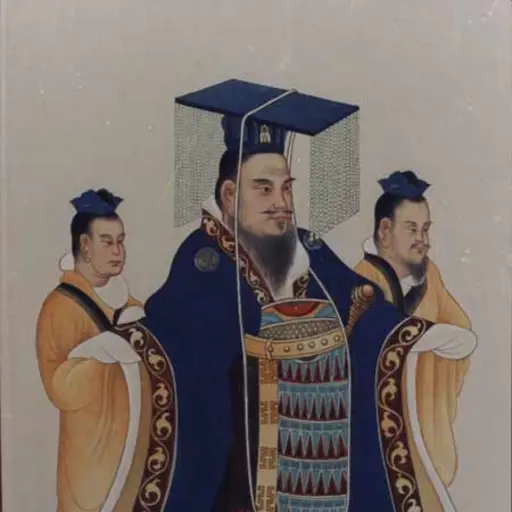

Fought back against the Xiongnu, opened the Western Regions and exalted Confucianism, setting the shape of the Han dynasty.
Life
Took the throne as a youth
Liu Che took the throne at 16 and in his early years was held in check by Empress Dowager Dou. The early Han followed the Huang-Lao doctrine of non-action and made marriage alliances (heqin) with the Xiongnu; the Rule of Wen and Jing had accumulated great wealth and population, providing the conditions for a turn to an expansionist policy, but the growing power of the vassal kings and local magnates and constant trouble on the northern frontier became ever more pressing problems.
Ambitious ventures at home and abroad
He adopted Dong Zhongshu's proposal to exalt Confucianism and established the Imperial Academy, used the Edict of Grace to weaken the vassal kings, brought salt, iron and liquor under state monopoly, and reformed the currency. He waged offensives against the Xiongnu for decades: Wei Qing and Huo Qubing repeatedly marched beyond the frontier, and the Battle of Mobei in 119 BCE drove the Xiongnu far away; he also sent Zhang Qian to open the Western Regions, opening the Silk Road.
Edict of remorse in old age
Prolonged warfare and enormous expenditure caused the registered population to plunge and drove refugees onto the roads everywhere; late in life he issued the Luntai Edict reviewing the failures of his campaigns. His reign set the territorial extent of the Han dynasty and the supremacy of Confucianism, and pioneered a mode of governance that was Confucian on the outside and Legalist within and relied on state monopolies; later ages have argued endlessly over his achievements and their cost.
Legacy
Reigning for fifty-four years, Emperor Wu of Han set the territorial scale of the Han dynasty and established the dominance of Confucianism in official ideology, and the systems he introduced, such as recommendation for office, era-name dating and the state monopoly on salt and iron, had far-reaching influence. However, years of continuous campaigns, lavish construction projects and the Wugu witchcraft affair of his late years badly drained the state's strength; Sima Guang judged that he "had the faults that ruined Qin but escaped the disaster that ruined Qin." Later generations often paired him with Qin Shi Huang as "the First Emperor of Qin and Emperor Wu of Han," and assessments of his merits and faults have always coexisted.
Major works & achievements
- Issued the Edict of Grace to weaken the vassal kings
- Established Erudites of the Five Classics and founded the Imperial Academy
- Crushed the main Xiongnu force at the Battle of Mobei
- Sent Zhang Qian to open the Western Regions and set up the four Hexi commanderies
- Adopted the Taichu calendar, making the first lunar month the start of the year
Did you know? China's practice of counting years by era names began with Emperor Wu of Han, and research suggests his first era name, "Jianyuan," was assigned retroactively later on.
Key dates
- 141 BCEAscends the throne
- 138 BCESends Zhang Qian on his first mission to the Western Regions
- 136 BCEAppointed erudites of the Five Classics and exalted Confucianism
- 127 BCEIssued the Edict of Grace, weakening the vassal kings
- 121 BCEHuo Qubing takes the Hexi Corridor
- 119 BCECrushes the Xiongnu at the Battle of Mobei
- 115 BCEIntroduced state monopolies on salt and iron
- 91 BCEWugu witchcraft affair; the crown prince committed suicide
- 89 BCEIssued the Luntai Edict, ending the wars to give the people rest