Huang Chao
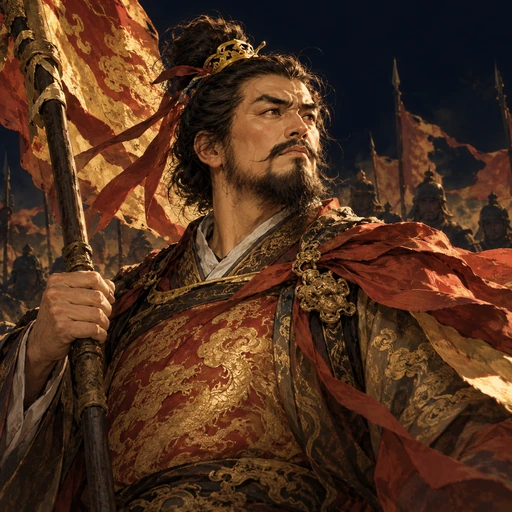
Rebel leader of a late Tang peasant uprising who entered Chang'an and proclaimed himself emperor; the uprising shook the foundations of the Tang dynasty.
Life
Failed examinee and salt merchant
Huang Chao was a wealthy salt merchant from Caozhou, skilled at riding and archery. He sat the jinshi exam several times without passing, and is said to have written a chrysanthemum poem: "When autumn comes, on the eighth of the ninth month, after my flowers bloom all other flowers will die."
Campaigned north and south
In 875 he joined Wang Xianzhi's uprising. After Wang Xianzhi was killed in battle in 878, he was chosen as chief and styled himself Heaven-Storming Generalissimo. He led his army south and captured Guangzhou, then turned north, taking Luoyang and Chang'an in 880; the next year he proclaimed himself emperor in Chang'an with the dynastic name Great Qi.
Proclaimed emperor in Chang'an
The rebels failed to consolidate their rule in Chang'an and faced a counteroffensive by the Tang army and the Shatuo leader Li Keyong, abandoning Chang'an in 883. In 884 Huang Chao was defeated and killed at Langhu Valley on Mount Tai. The uprising left the Tang dynasty in existence in name only.
Legacy
The Huang Chao Rebellion swept across most of China and destroyed the foundations of Tang rule; the Tang dynasty fell some twenty years later.
Did you know? His lieutenant Zhu Wen later surrendered to the Tang, and eventually usurped the Tang throne and founded the Later Liang.
Key dates
- 875Joined Wang Xianzhi's uprising
- 878Styled himself Heaven-Storming Generalissimo
- 879Captured Guangzhou
- 880Entered Chang'an
- 881Proclaimed himself emperor of Great Qi
- 884Defeated and killed