Li Si
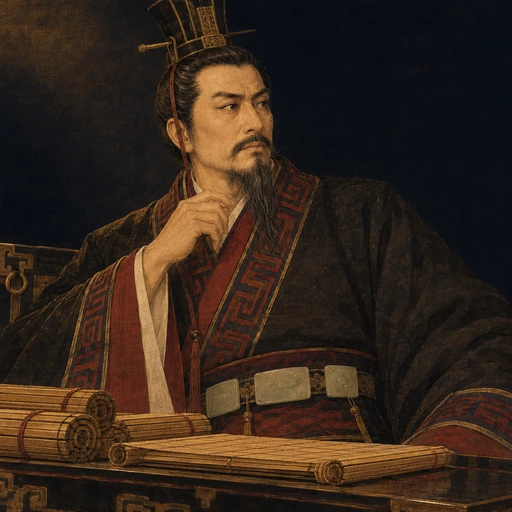
Helped Qin Shi Huang unify China, oversaw the unified script and the commandery-county system, and was later destroyed by Zhao Gao.
Life
The Granary Rat's Lesson
Li Si was a native of Shangcai in the State of Chu. As a young minor official in his commandery, he noticed the different lots of rats in a latrine and rats in a granary and sighed, "A man's worth or worthlessness is just like that of rats." He then studied the arts of rulership under Xunzi and later entered Qin as a retainer of Lü Buwei.
Helping Qin Unify the Realm
When the King of Qin issued an order expelling foreign officials, Li Si submitted the Petition Against Expelling Foreign Officials and had it revoked. He helped the king plan the strategy of unification, and after unification he strongly advocated abolishing enfeoffment in favor of commanderies and counties. He oversaw the standardization of writing with small seal script and proposed the burning of books to ban private learning, rising to chancellor.
Shaqiu and Execution by Waist-Cutting
After the First Emperor died at Shaqiu, he conspired with Zhao Gao to forge an imperial edict, forcing Fusu to commit suicide and placing Huhai on the throne. Afterward Zhao Gao dominated power, and Li Si was falsely accused of rebellion, subjected to the five punishments and cut in half at the waist in Xianyang. Before his execution he said to his son, "I wish I could once more take our yellow dog with you out the east gate of Shangcai to chase hares, but how could that ever be!"
Legacy
Li Si was the chief designer of the Qin institutions, and the commandery-county system and the unification of the script had far-reaching influence; but his role in the burning of the books and the forged edict at Shaqiu also makes him seen as one of those who hastened the Qin's rapid fall.
Major works & achievements
- Petition Against Expelling Foreign Officials
- Implemented the commandery-county system
- Standardized writing with small seal script
Did you know? The Mount Tai Stele, a Qin stone inscription, is traditionally said to be in Li Si's hand and is regarded as a model of small seal script.
Key dates
- 247 BCEEntered Qin as a retainer of Lü Buwei
- 237 BCESubmitted the Petition Against Expelling Guest Officials
- 221 BCEQin unification; advocated the commandery-county system
- 213 BCEProposed the burning of books
- 210 BCEShaqiu Incident; forged an edict with Zhao Gao to enthrone Huhai
- 208 BCECut in half at the waist in Xianyang