Augustus
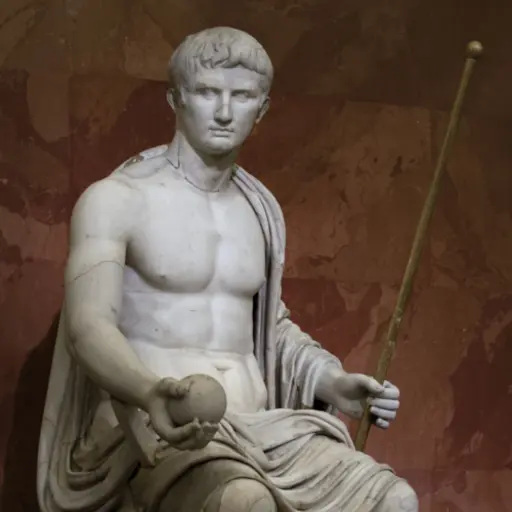

Ended the civil wars and established the Principate, ushering in 200 years of the Pax Romana.
Life
Succeeded as a youth
Octavian, later Augustus, was Caesar's grandnephew and heir under his will; he was only 18 when Caesar was assassinated. He hurried back to Rome to claim Caesar's political legacy, formed the Second Triumvirate with Antony and Lepidus, purged the republicans, and defeated Brutus and Cassius at the Battle of Philippi.
Ended the civil wars
He then divided the empire with Antony, he taking the west and Antony the east, but tensions between them deepened; in 31 BCE he won the Battle of Actium, and the next year he annexed Egypt, ending the civil wars. In 27 BCE he formally returned power to the Senate and received the title Augustus, while in fact concentrating military command, finances and tribunician power in his own hands, establishing the Principate.
Pax Romana
In his reign of more than 40 years he reorganized the provinces and taxation, created a standing army and the Praetorian Guard, and promoted moral legislation and public works, ushering in the Pax Romana that lasted 200 years. His system cloaked monarchy in republican dress and laid the foundation of imperial rule, but it also planted long-term dangers in its rules of succession and its loss of control over the army.
Legacy
Augustus ended a century of Roman civil war and founded the imperial system while preserving the forms of the Republic; later generations regarded his political skill as a model of how power is exercised. During his reign Roman literature and architecture reached their zenith: Virgil, Horace, Livy and others all enjoyed his patronage, and the month of August is named after his title. Yet in his early years he took part in the proscriptions and purged his political rivals with considerable ruthlessness, and historians such as Tacitus held that the "republican cloak" of the Principate was merely a disguise for autocracy.
Major works & achievements
- Defeated Antony and Cleopatra at the Battle of Actium
- Established the Principate and founded the Roman Empire
- Ushered in about two hundred years of the Pax Romana
- Reorganized the provinces and the tax system, and established a standing army
- Res Gestae Divi Augusti
Did you know? The full text of the Res Gestae Divi Augusti is inscribed on the walls of a temple in Ankara in today's Turkey, the most completely preserved copy.
Key dates
- 44 BCEInherited Caesar's legacy and entered politics
- 43 BCEForms the Second Triumvirate
- 42 BCEDefeats the Republicans at the Battle of Philippi
- 36 BCEDefeated Sextus Pompey and sidelined Lepidus
- 31 BCEDefeats Antony at the Battle of Actium
- 30 BCEAnnexed Egypt; end of the civil war
- 27 BCEReceived the title Augustus and established the Principate
- 2 BCEHailed by the Senate as Father of the Fatherland
- 14Died; succeeded by Tiberius