The world in 1984
1984, China: People’s Republic of China (Deng Xiaoping); Mesopotamia: Republic of Iraq (Saddam); Iran: Islamic Republic (Khamenei (President)); India: Republic of India (Rajiv Gandhi). The main event that year: Ethiopian famine.
1984: the table below lists the states and rulers of 50 regions of the world, followed by 14 events from around that year.
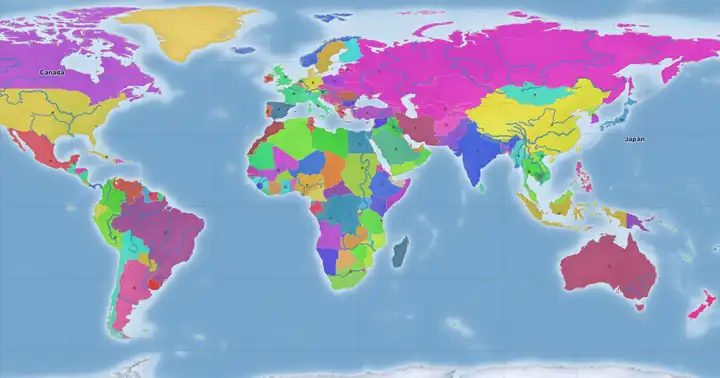
States and rulers by region
| Region | State or period | Ruler that year |
|---|---|---|
| United States | United States of America | Reagan |
| United Kingdom | United Kingdom | Thatcher |
| France | French Republic | Mitterrand |
| Germany | East and West Germany | Kohl |
| Rome | Italian Republic | Craxi |
| Turkey | Republic of Turkey | Evren |
| Egypt | Republic of Egypt | Mubarak |
| Mesopotamia | Republic of Iraq | Saddam |
| Russia | Soviet Union | Chernenko |
| Scandinavia | Sweden · Norway · Denmark | Carl XVI Gustaf (Sweden) |
| India | Republic of India | Rajiv Gandhi |
| China | People’s Republic of China | Deng Xiaoping |
| Japan | Postwar boom | Nakasone Yasuhiro |
| Greece | Hellenic Republic | Papandreou |
| North Africa | Algeria · Morocco · Tunisia | Gaddafi (Libya) |
| West Africa | Senegal · Mali · Niger | Traoré (Mali) |
| Ethiopia | Ethiopia | Mengistu Haile Mariam |
| Sudan | Republic of Sudan | Nimeiry |
| East Africa | Kenya · Tanzania · Uganda | Daniel arap Moi |
| Central African Republic | DR Congo | Mobutu Sese Seko |
| South Africa | Apartheid | P. W. Botha |
| Nigeria | Nigeria | Shagari |
| Ghana | Republic of Ghana | Rawlings (military) |
| Mexico | Crisis & transition | De la Madrid |
| Maya | Guatemala · Honduras · Belize | — |
| Inca | Peru · Bolivia · Ecuador | — |
| Mongolia | Mongolian People’s Republic | Batmönkh |
| Indonesia | Republic of Indonesia | Suharto |
| Australia | Commonwealth of Australia | Hawke |
| Spain | Kingdom of Spain | González (prime minister) |
| Portugal | Third Republic | Eanes (president) |
| Thailand | Thailand | Prem Tinsulanonda (Prime Minister) |
| Vietnam | Vietnam | Lê Duẩn (General Secretary) |
| Korean Peninsula | Division of Korea | South Korea · Chun Doo-hwan (President) / North Korea · Kim Il Sung |
| Iran | Islamic Republic | Khamenei (President) |
| Saudi Arabia | Kingdom of Saudi Arabia | King Fahd |
| Uzbekistan | Soviet era | Usmankhodjaev (First Secretary of the Communist Party of Uzbekistan) |
| Poland | Polish People’s Republic | Jaruzelski (First Secretary) |
| Netherlands | Modern Netherlands | Lubbers (Prime Minister) |
| Cambodia | People’s Republic of Kampuchea | Heng Samrin (President of the Council of State) |
| Myanmar | Military rule | San Yu (president); Ne Win (chairman of the Burma Socialist Programme Party) |
| Brazil | Military government | Figueiredo |
| Argentina | Democracy | Alfonsín |
| Canada | Canada | Mulroney |
| Austria | Second Republic | Fred Sinowatz |
| Ireland | Republic of Ireland | Garret FitzGerald |
| Afghanistan | PDPA government | Karmal |
| Caribbean | Revolution & independence | Fidel Castro |
| Baltic states | Soviet rule | — |
| Guyana | Military rule & unrest | — |
The “Ruler that year” column comes from TimelineSurf's dated lists of rulers and heads of government. A blank means no record for that year, not that the region had no ruler. A few lists are incomplete, so the name may be the most recent one on record.
Events around this year
- 1982Coalition Government of Democratic Kampuchea formed
The Sihanouk faction, the Son Sann faction and the Khmer Rouge formed the Coalition Government of Democratic Kampuchea, which kept its seat at the United Nations and remained locked in a prolonged standoff with the Phnom Penh government. - 1982Falklands (Malvinas) War
Argentina seized the Malvinas (Falkland Islands), and Britain sent a task force to retake them; the war lasted 74 days and ended in Argentina's defeat, after which the military government quickly lost its grip on power. The two sides still hold different positions on sovereignty. - 1983Restoring democracy
Alfonsín was elected President and immediately set up the National Commission on the Disappearance of Persons, which published its report, Nunca Más ("Never Again"), the following year. - 1983Second Sudanese Civil War breaks out
After southern autonomy was revoked and Islamic law was imposed nationwide, the Sudan People's Liberation Movement arose, and civil war continued for more than twenty years. - 1984Ethiopian famine
Drought combined with war caused a great famine, with deaths estimated at hundreds of thousands to a million, and the international community launched a massive relief effort. - 1984Upper Volta renamed Burkina Faso
After taking power, Thomas Sankara renamed the country Burkina Faso, meaning "land of upright people"; he was killed in a coup in 1987. - 1984Itaipu Dam begins generating power
The Itaipu Dam, built jointly by Paraguay and Brazil on the Paraná River, began generating power and was long one of the world's largest hydroelectric plants by output. - 1984Assassination of Indira Gandhi
Indira Gandhi was assassinated by her Sikh bodyguards; earlier she had ordered the army into the Golden Temple in Amritsar to clear out Sikh militants. - 1984Bhopal gas leak
A gas leak at a pesticide plant in Bhopal killed several thousand people outright, one of the worst industrial disasters in the world. - 1985Civilian government restored
The electoral college chose Tancredo Neves as president, but he fell ill and died before taking office, and Vice President Sarney succeeded him. - 1985Trial of the Juntas
A civilian court publicly tried the former heads of the military government, and Videla and Massera were sentenced to life imprisonment. - 1985Death of Enver Hoxha
Enver Hoxha, who had ruled for forty years, died and was succeeded by Ramiz Alia. - 1985Mexico City earthquake
A magnitude 8.0 earthquake devastated Mexico City, killing an estimated 10,000 or so people; the rise of grassroots self-help organizations shaped politics in the years that followed. - 1985Plaza Accord
The finance ministers of five countries agreed on joint intervention in currency markets; the yen appreciated sharply, followed by an asset bubble.