The world in 1811
1811, China: Qing (Jiaqing); Iran: Qajar dynasty (Fath-Ali Shah); India: East India Company rule (Minto); Rome: Napoleonic era (Murat (King of Naples)). The main event that year: Brief British rule.
1811: the table below lists the states and rulers of 48 regions of the world, followed by 14 events from around that year.
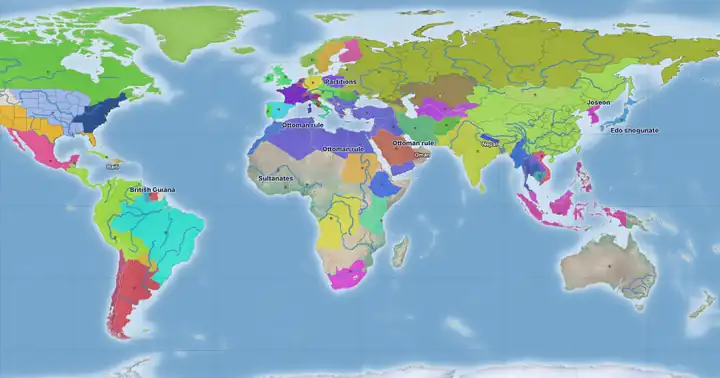
States and rulers by region
| Region | State or period | Ruler that year |
|---|---|---|
| United States | United States of America | Madison |
| United Kingdom | Kingdom of Great Britain | — |
| France | Napoleonic Empire | Napoleon I |
| Germany | Confederation era | Napoleon I (Protector of the Confederation of the Rhine) |
| Rome | Napoleonic era | Murat (King of Naples) |
| Turkey | Ottoman Empire | Mahmud II |
| Egypt | Muhammad Ali dynasty | Muhammad Ali |
| Mesopotamia | Ottoman rule | — |
| Russia | Russian Empire | Alexander I |
| Scandinavia | Denmark–Norway · Sweden | Charles XIII (Sweden) |
| India | East India Company rule | Minto |
| China | Qing | Jiaqing |
| Japan | Edo shogunate | Tokugawa Ienari |
| North Africa | Ottoman rule | Yusuf Karamanli (Tripoli) |
| West Africa | Sultanates | — |
| Ethiopia | Solomonic dynasty | Era of the Princes (rule of regional lords) |
| Sudan | Funj Sultanate | Muhammad al-Fadl (Darfur) |
| East Africa | Oman / Zanzibar | Said bin Sultan |
| South Africa | Dutch Cape Colony | Janssens (Batavian Republic) |
| Nigeria | Sokoto Caliphate | Usman dan Fodio |
| Ghana | Ashanti Confederacy | Osei Bonsu |
| Mexico | War of Independence | Morelos (Rebel leader) |
| Maya | Spanish conquest | — |
| Inca | Viceroyalty of Peru | — |
| Mongolia | Qing Mongolia | — |
| Indonesia | Dutch East Indies | Raffles (British occupation) |
| Australia | British penal colonies | Macquarie |
| Spain | Peninsular War | Joseph I (installed by France) |
| Portugal | House of Braganza | John (Prince Regent) |
| Thailand | Chakri dynasty | Rama II |
| Vietnam | Nguyễn dynasty | Emperor Gia Long Nguyễn Phúc Ánh |
| Korean Peninsula | Joseon | Sunjo of Joseon |
| Iran | Qajar dynasty | Fath-Ali Shah |
| Saudi Arabia | First Saudi State | Saud ibn Abdulaziz |
| Uzbekistan | Manghit dynasty | Haydar |
| Poland | Partitions | Frederick Augustus I (Duke of Warsaw, King of Saxony) |
| Netherlands | Batavian Republic & Napoleonic Holland | Annexed to the French Empire (Lebrun as governor-general) |
| Cambodia | Post-Angkor period | Ang Chan II |
| Myanmar | Konbaung dynasty | Bodawpaya |
| Brazil | Portuguese Brazil | Prince Regent John (royal court in Rio) |
| Argentina | War of Independence | First Triumvirate |
| Canada | British North America | Prevost |
| Austria | Austrian Empire | Francis I |
| Ireland | Part of the United Kingdom | George III |
| Afghanistan | Durrani Empire | Mahmud Shah (restored) |
| Caribbean | Abolition era | — |
| Baltic states | Baltic provinces of the Russian Empire | — |
| Guyana | British Guiana | — |
The “Ruler that year” column comes from TimelineSurf's dated lists of rulers and heads of government. A blank means no record for that year, not that the region had no ruler. A few lists are incomplete, so the name may be the most recent one on record.
Events around this year
- 1810Cry of Dolores
Hidalgo issued the Cry of Dolores, igniting the Mexican War of Independence. - 1810May Revolution
On May 25, the town council of Buenos Aires deposed Viceroy Cisneros and set up the First Junta; this day is regarded as the starting point of the Argentine nation. - 1810Caracas revolution
On April 19, the town council of Caracas deposed the Spanish captain general and set up a governing junta, beginning Venezuela's independence movement. - 1810University of Berlin founded
Under the direction of Wilhelm von Humboldt, the University of Berlin was founded on the principles of the "unity of teaching and research" and academic freedom; it became the model of the modern research university and is today called the Humboldt University of Berlin. - 1811Brief British rule
The Napoleonic Wars reached the Far East: the United Kingdom occupied Java, and Raffles introduced land-tax reform and oversaw the excavation of Borobudur; five years later Java was returned to the Netherlands. - 1811Paraguayan Independence
After repelling an expedition sent from Buenos Aires, Paraguay overthrew the Spanish governor and established itself as an independent state. - 1811Hidalgo executed
After the rebels' defeat at the Calderón Bridge, Hidalgo was captured during the withdrawal north and executed in Chihuahua; the War of Independence continued under the leadership of Morelos. - 1811Massacre of the Mamluks at the Citadel
Muhammad Ali lured the Mamluk chiefs to a banquet at the Cairo Citadel and had them killed, wiping out the old military elite for good. - 1811Venezuela declares independence
On July 5, Venezuela's National Assembly declared independence, making it the first country in Spanish America to do so; Miranda became commander-in-chief. - 1811Hong Gyeong-nae's Rebellion
In Pyeongan Province of Joseon, Hong Gyeong-nae led a peasant uprising against regional discrimination and tyrannical rule, occupying much of the territory north of the Cheongcheon River before being suppressed the following year. - 1812Constitution of Cádiz
Meeting in besieged Cádiz, the resistance Cortes passed Spain's first constitution, establishing national sovereignty and constitutional monarchy; it became a model for liberals in southern Europe and Latin America. - 1812War of 1812
The United States declared war on Britain and invaded Upper and Lower Canada; the British army, Canadian militia and Indigenous allies such as Tecumseh drove them back, and the war ended in 1814 with a return to the prewar status quo. - 1812Napoleon invades Russia
Napoleon invaded Russia with an army of about 600,000 and entered Moscow after the Battle of Borodino, but the burning of Moscow and the harsh winter forced him to retreat, and his Grande Armée was nearly annihilated. - 1812War of 1812
The United States went to war with Britain (the War of 1812); British troops at one point entered Washington and burned the White House, and the Treaty of Ghent, signed in 1814, restored the prewar status quo.