Suleiman the Magnificent
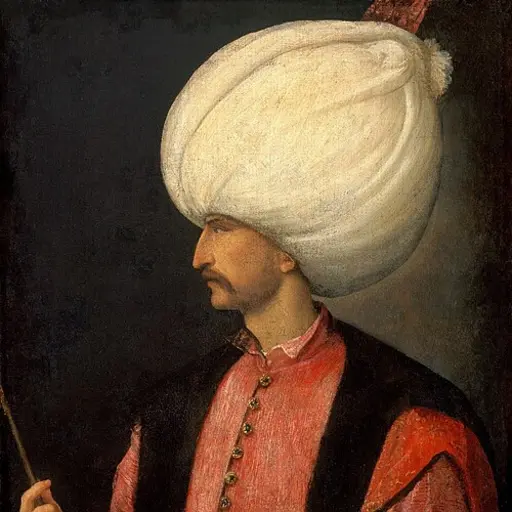

Sultan of the Ottomans at their zenith, known as the Lawgiver.
Life
Heir to the empire
Suleiman was the only son of Selim I and came to the throne in 1520. By then the Ottomans had conquered Constantinople, Syria and Egypt, controlled the holy places of Islam and the trade routes of the eastern Mediterranean, and were immensely powerful, while Europe was mired in the rivalry between the Habsburgs and France and the divisions brought by the Reformation.
Thirteen personal campaigns
In his 46-year reign he led 13 campaigns in person: he took Belgrade in 1521, captured Rhodes in 1522, crushed Hungary at Mohács in 1526 and besieged Vienna without success in 1529. At sea his fleet under Barbarossa dominated the Mediterranean, and in the east he fought repeated wars with Safavid Persia, at one point taking Baghdad.
Lawgiver and later years
He reorganized the law codes, earning the title of Lawgiver; he relied on his grand viziers and the architect Sinan and oversaw projects such as the Süleymaniye Mosque, while literature and miniature painting flourished. In his later years he executed his eldest son amid a succession struggle, and the empire's administration gradually fell under the control of the harem and the bureaucracy. His reign is generally regarded as the peak of the Ottomans.
Legacy
The reign of Suleiman the Magnificent is usually regarded as the Golden Age of the Ottoman Empire: the empire spanned three continents, and law, architecture and literature all reached their height. The Turks call him "Kanuni" (the Lawgiver), while Europeans call him "the Magnificent." On the other hand, he had two of his adult sons put to death, and court factions and harem politics gradually grew in power; some historians believe the empire's later stagnation was already foreshadowed in his final years.
Major works & achievements
- Crushed Hungary at the Battle of Mohács in 1526
- 1529: besieged Vienna
- Reorganized the law code and became known as "the Lawgiver"
- Commissioned Sinan to build the Süleymaniye Mosque
Did you know? He wrote poetry under the pen name "Muhibbi" and left behind a sizable collection of poems.
Key dates
- 1520Succeeds as sultan
- 1521Takes Belgrade
- 1522Captured Rhodes
- 1526Crushed Hungary at the Battle of Mohács
- 1529Failed siege of Vienna
- 1534Took Baghdad on an eastern campaign
- 1538Defeats the Venetian-led coalition at the Battle of Preveza
- 1553Executed his eldest son Mustafa
- 1566Campaigns in person in Hungary; dies of illness on campaign