Napoleon Bonaparte
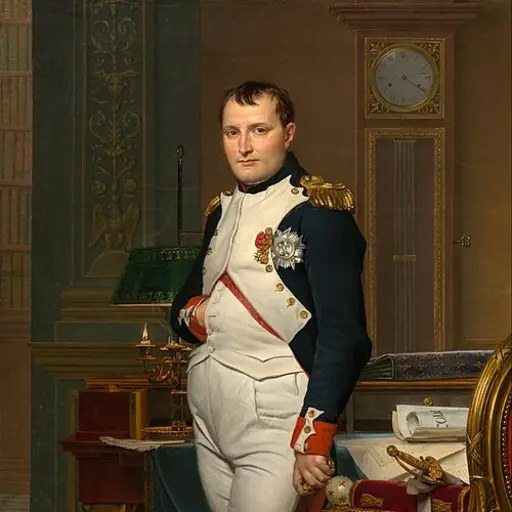

Issued the Civil Code and dominated continental Europe, but was ultimately brought down by years of continuous war.
Life
Corsican artillery officer
Napoleon was born into a petty noble family on Corsica, received a military education in mainland France and became an artillery officer. The French Revolution broke down the old barriers to advancement; he made his name at the Siege of Toulon, then put down a royalist uprising in Paris with artillery fire, and went on to command the Army of Italy, defeating Austria again and again.
Consul and emperor
In 1799 he seized power in the Coup of 18 Brumaire, and in 1804 he proclaimed himself emperor. He oversaw the compilation of the Civil Code, which enshrined equality before the law, property rights and freedom of contract, and he reformed finance, education and administration. Militarily he crushed the Anti-French coalitions at battles such as Austerlitz and Jena, extending French power over most of Europe.
Downfall and legacy
The Continental Blockade and the war in Spain were enormously costly; the invasion of Russia in 1812 cost him an army of 600,000, and in 1814 he abdicated. The next year, after the Hundred Days restoration, he was defeated at Waterloo and exiled to Saint Helena. His wars killed millions, but they also carried the legal code, standardized weights and measures and the idea of civic equality across Europe, hastening the collapse of the old order and the rise of nationalism.
Legacy
Napoleon is one of the most influential figures in modern Europe. His legal code and administrative and educational systems consolidated some of the gains of the French Revolution and, spread across Europe by conquest, profoundly changed the continent's legal and political map. But his continual wars caused millions of deaths, and measures such as restoring slavery and suppressing freedom of the press have drawn heavy criticism. In France he is both a symbol of national glory and a byword for despotism and war.
Major works & achievements
- Issued the French Civil Code
- Crushed the Anti-French coalitions at Austerlitz and other battles
- Founded the Bank of France
- Introduced a centralized administrative system
Did you know? The idea that "Napoleon was short" stems largely from confusion between English and French units of length and from British caricatures; he was in fact of average height.
Key dates
- 1793Made his name at the Siege of Toulon
- 1796Led the Army of Italy to victory
- 1798Expedition to Egypt
- 1799Coup of 18 Brumaire; becomes First Consul
- 1804Crowned emperor; promulgates the Civil Code
- 1805Great victory at Austerlitz
- 1812Disastrous invasion of Russia
- 1814Abdicates; exiled to Elba
- 1815Defeated at Waterloo; exiled to Saint Helena