Maximilian I
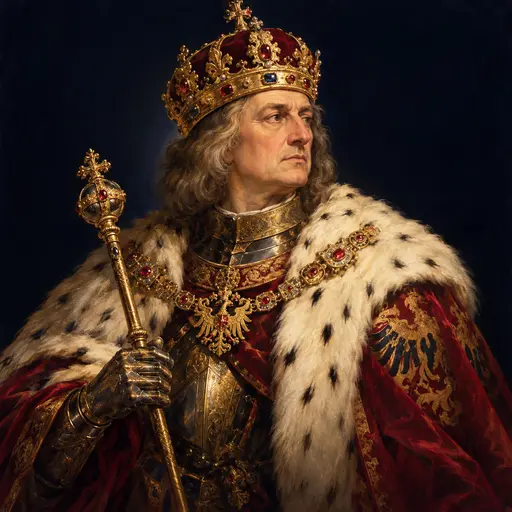
"The Last Knight," who through marriage alliances won the House of Habsburg the inheritance of Burgundy and Spain.
Life
Burgundian marriage
Maximilian was the son of Emperor Frederick III. In 1477 he married Mary, Duchess of Burgundy, and after Duke Charles the Bold of Burgundy was killed in battle, he fought France for years to hold the Netherlands and other wealthy lands.
The Last Knight
In 1493 he succeeded his father, and in 1508, without a papal coronation, he took the title "Elected Roman Emperor." He pursued Imperial Reform, establishing the Imperial Chamber Court, and raised the mercenary infantry known as the Landsknechte. A lover of tournaments and chivalric culture, he was called "The Last Knight," and he also patronized artists such as Dürer.
Empire built by marriage
He carefully arranged his descendants' marriages: his son Philip married the Spanish princess Joanna, and his grandson and granddaughter married into the Bohemian-Hungarian royal family, laying the groundwork for the dynasty's later inheritance of Spain, Bohemia and Hungary. He died in 1519.
Legacy
Maximilian I built a dynastic empire spanning Europe through marriage rather than war, and his grandson Charles V ruled lands "on which the sun never set."
Major works & achievements
- The autobiographical works Weisskunig and Theuerdank
Did you know? The Court Church in Innsbruck holds his enormous cenotaph, surrounded by twenty-eight life-size bronze statues.
Key dates
- 1477Marries Mary of Burgundy
- 1493Succeeds his father
- 1496His son Philip marries a Spanish princess
- 1508Proclaims himself Elected Roman Emperor
- 1515Double wedding in Vienna
- 1519Died