Karl Marx
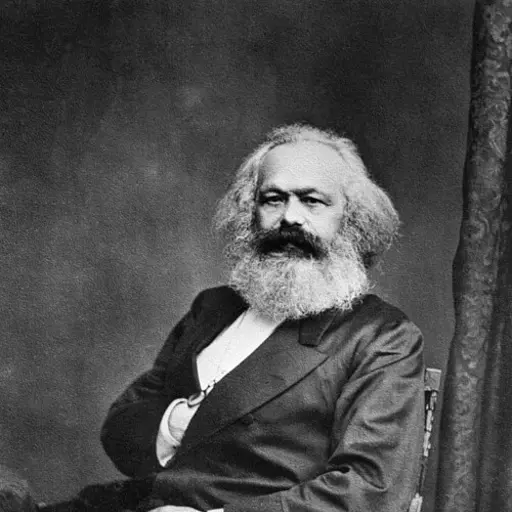

Proposed historical materialism and the theory of surplus value; wrote Capital.
Life
Youth in Trier
Marx was born into a lawyer's family in Trier, Prussia. At the University of Berlin he encountered Hegel's philosophy; his radical views barred him from an academic post, so he turned to newspaper editing. In 1840s Europe, industrialization brought urban poverty and workers' movements, and rival schools of socialist thought competed to offer solutions.
Manifesto and exile
Expelled from Prussia, France and Belgium for his writings, he co-wrote The Communist Manifesto with Engels, setting out class struggle and historical materialism. From 1849 he lived in long exile in London, studying economics in the British Museum and living in hardship; in 1867 he published Capital, Volume I, which analyzed surplus value and capital accumulation.
Capital and influence
He helped found the First International, advocating the international unity of workers. After his death his successors developed his doctrines into many schools, and in the 20th century they became the ideological foundation of many parties and states, with widely varying and deeply contested results in practice. As a framework for economic and social analysis, his influence persists in academic and political debate today.
Legacy
Marx was one of the most influential thinkers of the 19th century. His theories of historical materialism and surplus value laid bare the workings of capitalism and form the theoretical foundation of Marxism, exerting an enormous influence on the course of world history in the 20th century. His ideas are still widely studied and debated in economics, sociology, history and other fields.
Major works & achievements
- Co-wrote The Communist Manifesto with Engels
- Capital, Volume I
- Helped found the First International
- Proposed historical materialism
Did you know? After his death he was buried in Highgate Cemetery in London.
Key dates
- 1841Received a PhD in philosophy from the University of Jena
- 1843Moves to Paris; turns to political economy
- 1844Began his long collaboration with Engels
- 1848Published The Communist Manifesto
- 1849Exile in London
- 1864Helped found the First International
- 1867Published Capital, Volume I
- 1883Died of illness in London