Marcus Aurelius
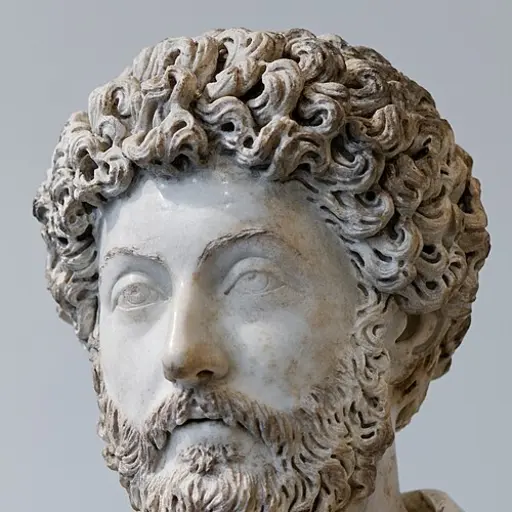

Last of the Five Good Emperors; wrote the Meditations, spreading Stoic philosophy.
Life
Making of a philosopher
Marcus Aurelius came from a Roman senatorial family of Spanish origin. Noticed by Hadrian as a boy, he was adopted by Antoninus Pius and carefully groomed. From childhood he was devoted to Stoic philosophy, studied under several renowned teachers of rhetoric and philosophy, and lived simply, holding himself to his duty.
Beset by war and plague
He took the throne in 161 CE and of his own accord shared power with his adoptive brother Lucius Verus. During his reign there was war with Parthia in the east, while in the north the Marcomanni crossed the Danube and invaded, and the empire was also devastated by a great plague that sharply reduced its population. He spent years in army camps on the frontier, writing private notes of self-reflection in Greek, which later circulated as the Meditations.
The last of the good emperors
He is regarded as the last of Rome's Five Good Emperors, after whom the empire entered a long period of turmoil. The Meditations stresses reason, duty and acceptance of fate, and became the most widely read text of Stoicism. His reign also continued the persecution of Christians, and his rule was not without controversy.
Legacy
Marcus Aurelius is often seen as the ruler who came closest to Plato's ideal of the philosopher-king. His Meditations, written as personal notes, set out his reflections on reason, duty, life and death, and it remains one of the most widely read works of philosophy today. But he broke with the custom of adopting the most capable heir and passed the throne to his own son Commodus, whose misrule brought the era of the Five Good Emperors to an end; historians such as Gibbon regard this as the turning point of Rome's decline.
Major works & achievements
- Meditations in twelve books
- Ruled jointly with Lucius Verus, setting the first precedent for two co-emperors in Rome
- Directed the Marcomannic Wars to defend the Danube frontier
- Established chairs for the four major schools of philosophy in Athens
Did you know? The bronze equestrian statue of Marcus Aurelius on Rome's Capitoline Hill escaped being melted down in the Middle Ages because it was mistaken for a statue of Constantine.
Key dates
- 138Adopted by Antoninus Pius
- 145Marries Faustina
- 161Took the throne and ruled jointly with Lucius Verus
- 162Parthian War breaks out
- 165Antonine Plague spreads
- 166Marcomannic Wars begin
- 170Stationed for years on the Danube front, writing his notes
- 177Makes Commodus co-emperor
- 180Dies of illness in an army camp in Pannonia