Johannes Gutenberg
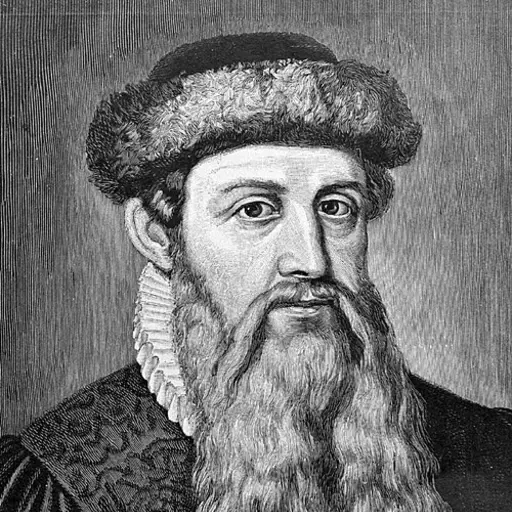

Developed metal movable type printing, greatly reducing the cost of books.
Life
Mainz craftsman
Johannes Gutenberg was born into a merchant family in Mainz and early on worked in metalworking and gem polishing. In 15th-century Central Europe cities were growing, demand for books from universities and the Church was soaring, yet manuscripts were costly and scarce and woodblock printing could not be reused, so improving copying technology had become a pressing problem for the trade.
Invented movable-type printing
After years of experiments in Strasbourg and Mainz, he combined lead-tin-antimony alloy type, oil-based ink, type casting from matrices and an adapted screw press into a complete process. Around 1450 he borrowed money to open a workshop, and c. 1455 printed the finely made Forty-two-line Bible, marking the beginning of movable type printing in the West.
Spread of the technology
He lost a lawsuit over his debts, his workshop and equipment were taken over by his creditor, and he lived in poverty in his later years. The technology, however, spread rapidly, and by 1500 Europe had over a thousand print shops. Printing greatly lowered the cost of books and accelerated the Reformation, the spread of science and the writing down of vernacular languages; it was one of the most crucial technological changes of the early modern era.
Legacy
Johannes Gutenberg's printing press multiplied the speed and volume of book production in Europe and is widely regarded as one of the most important inventions of the early modern period, providing the technical conditions for the Reformation, the Scientific Revolution and the spread of literacy. It should be noted that movable type printing was not first invented in Europe: Bi Sheng of the Northern Song had already made clay movable type, and Korea used metal movable type earlier. Gutenberg's contribution was a complete process suited to alphabetic scripts and capable of large-scale reproduction.
Major works & achievements
- Invented the process of casting metal movable type and printing with it
- Printed the Forty-two-line Bible c. 1455
- Improved oil-based ink and the screw press
Did you know? About forty-nine Gutenberg Bibles survive, of which only twenty-odd are complete.
Key dates
- 1434Worked as a metalsmith in Strasbourg
- 1439Partnership lawsuit reveals his printing experiments
- 1448Returned to Mainz to raise funds
- 1450Borrowed from Fust to open a print shop
- 1455Prints the Forty-two-line Bible and loses a debt lawsuit
- 1462Sack of Mainz scatters the printing artisans
- 1465Supported by the Archbishop of Mainz
- 1468Died