Genghis Khan
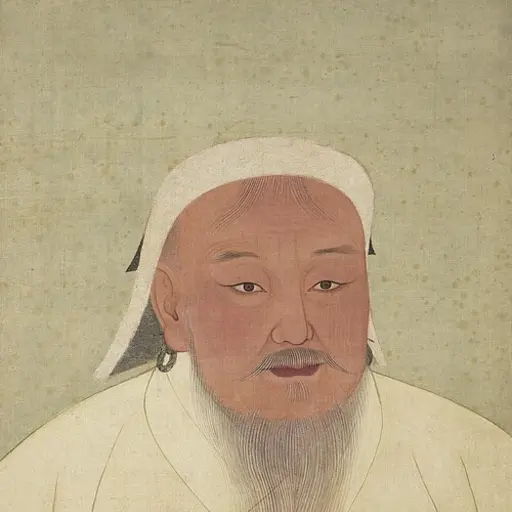

Unified the Mongol tribes and launched an expansion that redrew the political map of Eurasia.
Life
Orphan of the Steppe
Temüjin was born into the Kiyad clan of the Mongols. His father died when he was young, his people scattered, and he struggled to survive on the steppe with his mother and brothers. In the 12th century the Mongolian Plateau was divided among many tribes locked in endless feuds, and the Jin dynasty kept them divided and in check. He rose through alliances with Ong Khan of the Keraites and with Jamukha, gradually gathering followers and winning loyalty.
Unification and Institutions
After more than twenty years of campaigns he defeated the Tatars, Keraites and Naimans in turn, and in 1206 an assembly at the source of the Onon River proclaimed him Genghis Khan. He organized the thousand-household system, created the keshig guard, issued the Great Yassa, introduced a Mongol script and a relay-station network, then attacked the Western Xia and the Jin dynasty and launched the Western Campaign against Khwarazm.
Conquest and Legacy
Mongol expansion destroyed cities and killed huge numbers of people in Central Asia and North China; Samarkand, Urgench and other places were massacred. At the same time the empire opened Eurasian trade routes and intelligence networks, driving the transcontinental flow of technology, religions and diseases. After his death his descendants continued the western campaigns and built a system of states spanning Eurasia.
Legacy
The Mongol Empire founded by Genghis Khan was one of the largest land empires in history, and his successors built on it to establish the Yuan dynasty and several khanates. His organizational, military and legal innovations welded scattered steppe tribes into a powerful state. Assessments of him have always been sharply divided: his conquests caused immense destruction and loss of life in Central Asia, West Asia, North China and elsewhere, but the empire also promoted travel and exchange across Eurasia.
Major works & achievements
- 1206: Unifies the Mongol tribes; Founding of the Great Mongol State
- Created the thousand-household system and the keshig guard
- Promulgated the Great Yassa
- Orders the Mongolian language to be written in the Uyghur alphabet
- Launched the western campaign against Khwarazm
Did you know? His burial place has never been found and remains a famous unsolved mystery of archaeology.
Key dates
- 1189Elected chief of the Kiyad clan
- 1201Defeated Jamukha's coalition
- 1203Destroyed the Keraites
- 1204Conquers the Naimans and unifies the steppe
- 1206Assembly of the tribes; proclaimed Genghis Khan
- 1209Attacks Western Xia and forces its submission
- 1211Attacks the Jin; great victory at Yehuling
- 1219Western Campaign against Khwarazm
- 1227Died during the campaign against Western Xia