Suryavarman II
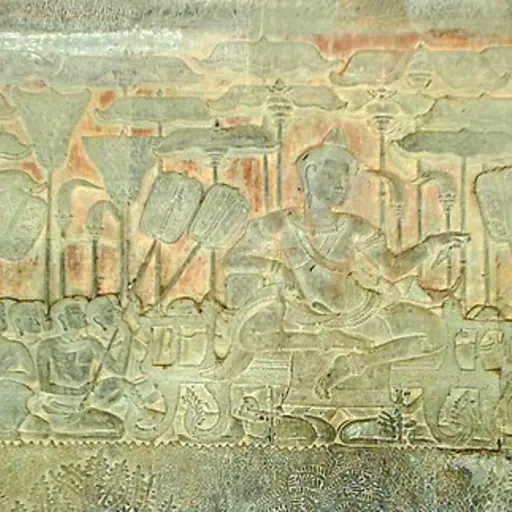

Builder of Angkor Wat, under whose reign Angkor expanded on a large scale to both the east and the west.
Life
Seizing the Throne and Unifying
Suryavarman II came from a collateral branch of the Angkorian royal family. Around 1113 he defeated his rivals and seized the throne; according to inscriptions, he once leapt onto an enemy's war elephant in battle. After his accession he ended decades of disputes over the throne, reunified the Angkorian kingdom, and restored relations with China, sending envoys to the Song in 1116.
Wars East and West
His reign saw continual warfare abroad: he sent armies against Đại Việt several times, all without success; in 1145 he invaded Champa and occupied its capital Vijaya for several years; to the west he controlled Lavo in the Chao Phraya basin, extending his power into what is now central Thailand. The reliefs of the southern gallery of Angkor Wat depict his army and court, including a troop of soldiers labeled "Syam," often regarded as an early depiction in stone of the ancestors of the Thai people.
Angkor Wat
Suryavarman II's greatest legacy is Angkor Wat. This temple-mountain dedicated to Vishnu was begun shortly after his accession, took several decades to build, and was completed around the time of his death; it is the largest religious structure in the world. Angkor Wat faces west and is generally thought to have served both as a state temple and as the king's mausoleum. Its gallery reliefs run for hundreds of meters, depicting myths from the Ramayana and the Mahabharata as well as the Churning of the Ocean of Milk. He died c. 1150, and his posthumous name means "he who has gone to the supreme abode of Vishnu."
Legacy
Under Suryavarman II, the territory and influence of the Khmer Empire (Angkor) reached a peak. Angkor Wat, built under his direction, is regarded as the pinnacle of Khmer architecture and sculpture and is today a national symbol of Cambodia. But his years of campaigns against Đại Việt and Champa achieved little and drained the state's strength; a few decades after his death, a Cham counterattack even captured Angkor, which was not recaptured until the time of Jayavarman VII.
Major works & achievements
- Unifies the Angkorian kingdom and ends the succession disputes
- Sent envoys to the Song in 1116
- Captured the Champa capital in 1145
- Oversaw construction of Angkor Wat
Did you know? An image of Angkor Wat appears on the national flag of Cambodia.
Key dates
- 1113Seized the throne c. this year
- 1116Sent envoys to the Song
- 1128Began military campaigns against Đại Việt
- 1145Invaded Champa and occupied Vijaya
- 1150Died c. this year; Angkor Wat largely completed