Ulugh Beg
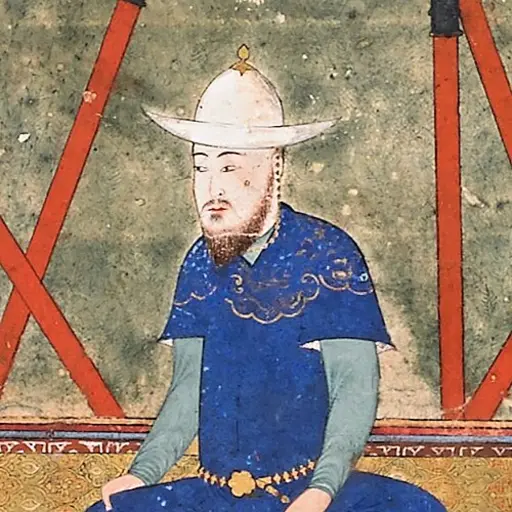

Grandson of Timur who governed Samarkand for nearly forty years, built a giant observatory and compiled the Zij-i Sultani (Ulugh Beg's star catalog); one of the most outstanding astronomers of the Middle Ages.
Life
Grandson of Timur
Ulugh Beg, born Muhammad Taraghay, was born in 1394 at Soltaniyeh during Timur's Western Campaign, and in childhood moved from place to place with his grandfather's army. After Timur's death his father, Shah Rukh, seized power over the empire and made Herat his capital, and in 1409 appointed Ulugh Beg, then barely in his teens, to govern Samarkand and Transoxiana. For nearly forty years thereafter Ulugh Beg was in effect the ruler of Transoxiana, but he was better known as a scholar.
Stargazing in Samarkand
Ulugh Beg loved mathematics and astronomy. In 1420 he completed a madrasa on Samarkand's Registan square, where he lectured on astronomy himself and gathered scholars such as al-Kashi, Qadi Zada al-Rumi and Ali Qushji. Around the late 1420s he built an observatory outside the city, whose central instrument was a giant meridian arc with a radius of about 40 meters. The star catalog compiled from its observations, Ulugh Beg's Zij, listed about a thousand stars and was the first major star catalog since Ptolemy based on new systematic observations; its measured length of the sidereal year differs from the modern value by less than a minute.
Defeated and killed
When Shah Rukh died in 1447, Ulugh Beg succeeded to the throne, but lacking political and military ability, he was soon embroiled in struggles with his nephew and with his eldest son, Abd al-Latif. In 1449 he was defeated and captured, and he was killed on his way to make the pilgrimage to Mecca. The observatory then fell into ruin and was not rediscovered until 1908, by the archaeologist Vyatkin. His star catalog reached the Ottomans through Ali Qushji and was translated into Latin in the 17th century, winning the attention of European astronomers.
Legacy
Ulugh Beg was a rare scholar-monarch. The Samarkand observatory he directed represented the highest achievement of 15th-century Islamic astronomy, and his star catalog surpassed its predecessors in accuracy and was transmitted by Ottoman and European scholars. Yet he failed repeatedly in politics and war; only two years after succeeding to the throne he was killed in a plot instigated by his eldest son, and the observatory fell into ruin. Later generations often cite his fate to show how much scholarly flourishing depends on political patronage.
Major works & achievements
- The Zij-i Sultani star catalog of Ulugh Beg, listing about a thousand stars
- Built the Samarkand observatory and its giant meridian arc
- Completed the madrasa on the Registan in 1420
- Measured the length of the sidereal year with an error of less than a minute
Did you know? A crater on the Moon is named after him.
Key dates
- 1394Born in Soltaniyeh
- 1409Governed Samarkand
- 1420Registan madrasa completed
- 1429Observatory completed c. this time
- 1437Preface to Ulugh Beg's star catalogue written
- 1447Succeeded to the throne of the Timurid Empire
- 1449Killed after defeat