Diponegoro
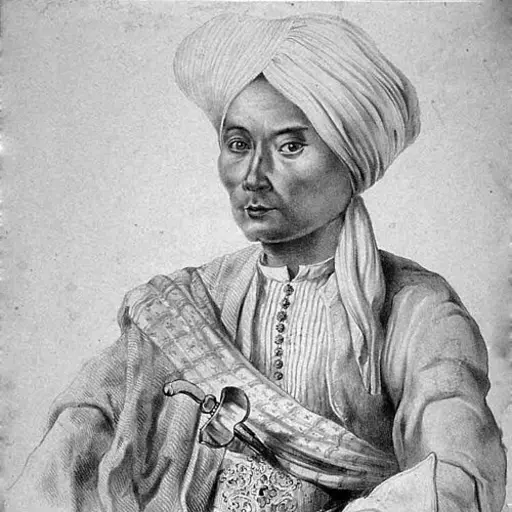

Prince of Yogyakarta who led the Java War against Dutch colonial rule and was later honored as an Indonesian national hero.
Life
Prince of a junior consort
Diponegoro was born in Yogyakarta in 1785, the eldest son of Sultan Hamengkubuwono III, but because his mother was not the principal consort, he could not succeed to the throne. Raised by his great-grandmother at Tegalrejo outside the city, he was a devout Muslim, often associated with village religious figures, and was well versed in the Javanese tradition of mysticism. He deeply resented the extravagance of the court and the ever-deepening interference of the Dutch.
Java War
In the 1820s the Dutch colonial authorities took back land that nobles had leased to Europeans and Chinese and demanded that the nobles pay compensation, while heavy tolls at checkpoints everywhere impoverished the peasants. In 1825 the Dutch built a road through the Diponegoro family's burial ground at Tegalrejo, which became the spark. He rose in revolt with the call of the "Just King," winning broad support from peasants, religious scholars and some nobles, and the Java War broke out, spreading across most of Central Java and East Java.
Exile and posthumous recognition
The Dutch commander De Kock switched to tactics of building a network of forts and dividing and encircling the enemy, and the rebels were gradually driven into a corner. In March 1830, Diponegoro was seized by the Dutch when he came to Magelang at their invitation to negotiate; he was then exiled to Manado in Sulawesi and later moved to Makassar, where he died in 1855. The autobiographical poem he wrote in exile, the Babad Diponegoro, has been inscribed on UNESCO's Memory of the World Register. In 1973 the Indonesian government posthumously recognized him as a national hero.
Legacy
The Java War led by Diponegoro lasted five years and was the largest resistance the Dutch faced on Java, inflicting heavy losses on the colonial authorities; after the war the Netherlands introduced the Cultivation System to restore its finances. In Indonesia he is honored as a national hero who resisted colonial rule. Some studies note, however, that his revolt was also colored by a court succession dispute and religious revival, and was not simply a modern nationalist movement.
Major works & achievements
- Rose in revolt in 1825, launching the Java War
- Rallied the people as the "Just King"
- Wrote the "Babad Diponegoro" in exile
Key dates
- 1785Born in Yogyakarta
- 1825Rose in revolt against the Dutch; the Java War breaks out
- 1827Dutch forces adopted a fortress strategy, and the rebels fell into difficulty
- 1830Detained during negotiations at Magelang and exiled to Sulawesi
- 1855Died in Makassar
- 1973Posthumously recognized as an Indonesian national hero