Ly Cong Uan
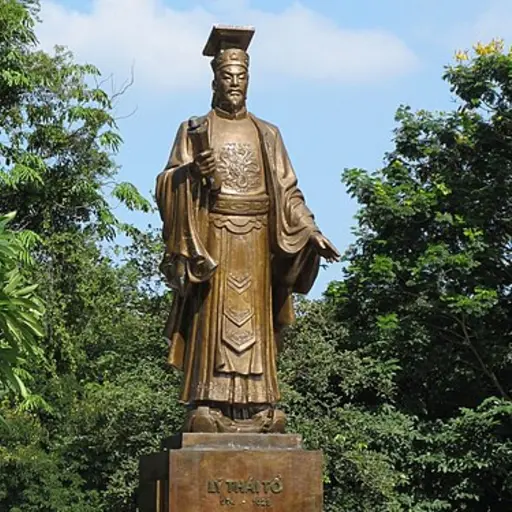

Founding emperor of the Lý dynasty, who moved the capital to Thăng Long (today's Hanoi).
Life
Boy of Cổ Pháp Temple
Lý Công Uẩn was born in Cổ Pháp, Bắc Giang (in today's Bắc Ninh); his origins are unknown. As a child he was placed in the care of Cổ Pháp Temple, where he studied under eminent monks such as Vạn Hạnh and was steeped in Buddhism. As an adult he entered court service, rising under the Early Lê dynasty to commander of the palace guard in charge of the imperial bodyguard. Generous and prudent, he won the trust of officials and monks and built up considerable prestige both at court and beyond.
Founding a Dynasty and Moving the Capital
In 1009 the brutal Lê Ngọa Triều died, leaving a young heir; officials and monks such as Vạn Hạnh raised Lý Công Uẩn to the throne, founding the Lý dynasty. In 1010 he issued the Edict on Moving the Capital, judging that Hoa Lư, hemmed in by mountains, was unfit to be the seat of an imperial enterprise, and decided to move the capital to the citadel of Đại La on the Red River plain. Legend says that when his fleet arrived a golden dragon was seen rising into the sky, so the city was renamed Thăng Long ("Ascending Dragon"). For nearly 800 years afterward it remained Vietnam's political center.
Foundation and Legend
During his reign Lý Công Uẩn built many Buddhist temples, reduced taxes and reorganized local administration, laying the foundations for more than two centuries of Lý dynasty stability. The Edict on Moving the Capital is regarded as one of the earliest surviving important political texts in Vietnam. In 2010 Hanoi celebrated the millennium of its founding, and his statue stands beside Hoan Kiem Lake. The histories, however, are full of supernatural embellishments about his early origins, and the facts are now hard to establish.
Legacy
The Lý dynasty founded by Lý Công Uẩn ruled for more than two hundred years and was the first long-lasting, stable dynasty in Vietnamese history. Thăng Long, the site he chose, is today's Hanoi and long remained Vietnam's political center thereafter. During his reign he venerated Buddhism and governed leniently, and Buddhism flourished under the Lý dynasty. Because early sources are limited and full of supernatural elements, the details of his origins and accession remain to be verified.
Major works & achievements
- Founded the Lý dynasty in 1009
- Issues the Edict on Moving the Capital and moves the capital to Thăng Long
- Builds Buddhist temples on a grand scale and reduces taxes
Key dates
- 974Born in Cổ Pháp
- 1005Lê Long Đĩnh takes the throne; Lý Công Uẩn becomes commander of the palace guard
- 1009Raised to the throne, founds the Lý dynasty
- 1010Issues the Edict on Moving the Capital; capital moved to Thăng Long
- 1028Dies; succeeded by Crown Prince Lý Phật Mã