Alfonso X of Castile (the Wise)
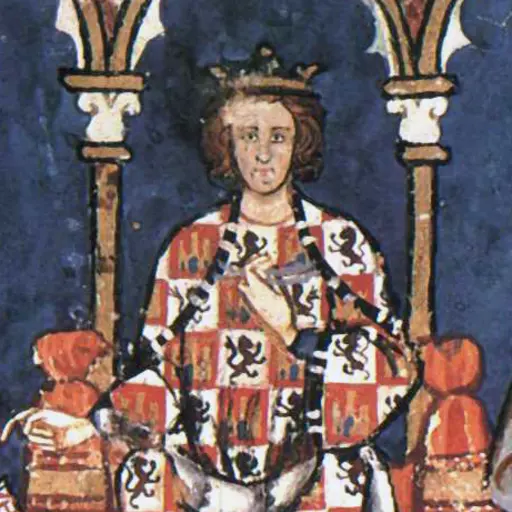

Oversaw the compilation of law codes, astronomical tables and histories, making Castilian a language of scholarship.
Life
Crown Prince on Campaign
Alfonso X was born in Toledo, the eldest son of Ferdinand III, and as a young man took part in his father's conquests of Murcia and Seville. When he succeeded to the throne in 1252, Castile had just extended its territory into the Guadalquivir valley, and the kingdom needed to bring the Muslims, Jews and Christian settlers of the newly conquered lands under a single legal and administrative system.
Scholarship of the Wise
He gathered Christian, Jewish and Muslim scholars in Toledo and Seville to translate and compile Arabic works on astronomy, history and law, overseeing the completion of the Siete Partidas, the Alfonsine Tables and the Estoria de España, and he composed more than 400 Cantigas de Santa Maria in Galician-Portuguese. He insisted on writing in Castilian rather than Latin, laying down the written norms of the language.
Political Setbacks
His political career, however, met repeated setbacks: he spent vast sums over nearly twenty years in a vain bid for the Holy Roman imperial throne, suppressed the Mudéjar revolt in 1264, and late in life fought a civil war with his second son Sancho over the succession, dying with most of the kingdom already in Sancho's hands. Later generations called him "the Wise," and often remarked that he excelled at learning but was inept at governing.
Legacy
Alfonso X was one of the most important patrons of learning in medieval Europe. The translation and compilation projects he organized brought a great deal of Arabic scientific knowledge into Europe; the Siete Partidas long influenced the law of Spain and its American colonies, and the Alfonsine Tables remained in use in Europe for about 300 years. He wrote in Castilian, laying the foundation of written Spanish. But his pursuit of the imperial crown, heavy taxes and the civil war with his son in his later years have led many to see him as better at scholarship than at governing.
Major works & achievements
- Oversaw compiling the Siete Partidas
- Alfonsine Tables
- Estoria de España
- Cantigas de Santa Maria
- Promoted the translation work in Toledo
Did you know? The Alphonsus crater on the Moon is named after him.
Key dates
- 1221Born in Toledo
- 1248Helps his father take Seville
- 1252Succeeds as King of Castile and León
- 1256Oversaw compiling the Siete Partidas
- 1257Elected King of the Romans in a disputed double election
- 1264Suppresses the Mudéjar revolt
- 1282Second son Sancho rises in revolt to seize power
- 1284Died in Seville